Istanbul formerly known as Byzantium and Constantinople, is a city of 16 million people, today we started exploring some it. The city is spread across the Bosphorus River and the Golden Horn (an estuary), it spans two continents and lies at the cross roads of both the Silk Route and the Spice Route.
It’s this later feature that has formed the city into what it is today. In its history it has been ransacked, pillaged and ruled by some of the most powerful historical Empires.
It was colonised by the Greeks in 667 BCE, and named Byzantium, in 196 BCE the Romans took control and built it into a major hub of their empire. In 330CE Constantine the Great renamed the city Constantinople and made it the capital of the Roman Empire, which over time evolved into the Byzantine Empire. In 1204 CE the western European Crusaders stormed the city and briefly established a Latin Empire. In 1453 led by Mehmed II, the Ottoman’s took over Constantinople, this began the conversion into a majority Muslim city and it became the capital of the Ottoman Empire. With the fall of the Ottoman Empire in 1923 and the formation of the Republic of Turkey, the capital was moved to Ankara, Istanbul gained its name in 1930, and has its heart of Turkiye. Sorry for the history lesson, but that may help make sense of our day.
We were picked up by our guide Ozan at 9am and went to the Hippodrome. A structure built by the Romans for chariot races that had a capacity of 100,000 people. There is little left today of the 440m x 140m structure, but the spine remains. It now contains two large Obelisks and the remnants of a brass pole that marked the centre point of all the worlds religions. So many interesting stories.
From there we took a short walk to the famous Blue Mosque, or more properly Sultan Ahmet Camii. It was opened in 1616 to rival the Byzantine era Hagia Sophia a short distance away. It is unusual as it has 6 minarets (most mosques only have 4). It’s an impressive structure with a huge dome, the world’s biggest when it was built, and has a capacity for 10,000 people at prayer time. It gets its “Blue” title from the extensive use of blue hued decorations throughout the complex.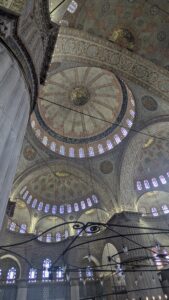
Next we went to The Topkapi Palace Museum. A lavish palace of the Ottoman Empire. We spent time walking around the various sections of the palace admiring the collections of jewellery, furnishings, various art works and the magnificent buildings. We got some great views over the Bosphorus River and the Golden Horn. As part of the Palace there were huge public kitchens, capable of feeding up to 10,000 people a day, a huge undertaking of the Sultan.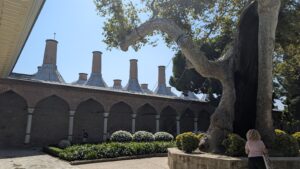
After lunch we went to Hagia Sophia (Holy Wisdom), a building with a very different history. It was built as Constantinople’s central cathedral in the 4th century, but its wooden roof burnt down, and it was rebuilt in the 5th century. This incarceration also had a wooden structure and suffered a major fire. It was rebuilt in the form we know it today by the Byzantine Emperor Justinian I. Over the years it has undergone many renovations and use changes. It has been a Catholic Church, an Orthodox Church and an Islamic mosque, as it is today. In its interior you can see clear evidence of all its incarnations. We were told that it will soon close to allow major renovations to be undertaken that may take 10 years to complete.
We then went underground to visit the Basilica Cistern, the largest of Istanbul’s under ground water storage reservoirs. Built by the Byzantine Empire to supply the city with water during the very dry summer months. It is one of about 260 cisterns in the city. It covers an area of about10,000 sq m, capable of holding 80,000 cubic meters of water.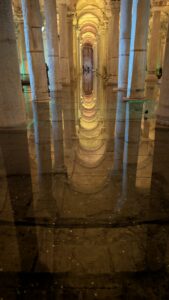 Today it is a tourist attraction and has a few art installations scattered around it.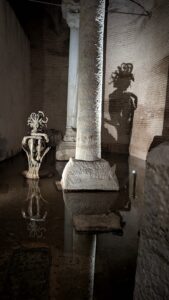
And then we walked to the Grand Bazaar, the worlds largest, and oldest, under cover markets, with over 4,000 shops. It was nothing like I expected, it’s not a massive array of stalls in a labyrinth of lanes, but instead it is a very orderly array of formal shops under a vast connection of old buildings. The floors are tiled, some with marble, and it is all very organised and clean, well except for the confronting effects of people smoking inside. 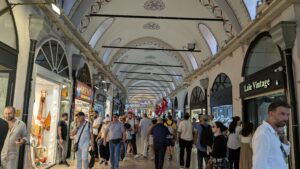 We (I) bought a few mementos and we left after walking around looking at various shops.
It was late when we left, so rather than get a taxi into the peak hour traffic chaos, we chose public transport to get back to our hotel. We got a tram then an underground funicular and we were back at our hotel at around 6pm. A huge 9 hour day, including about 18,500 steps (14+km)
A great day, but we are a bit tired!
Subscribe to our blog
Search our site
Site Visit counter
Visits since 1 Feb 2020

1234,544 visits up to 31 Jan 2020Log in
Pages
- About this Site
- GregnDeb by Map
- 2006 England, Scotland and Italy
- 2007 Central Australian Outback
- 2007 – 2008 Antarctica and South America
- 2008 Vietnam & Cambodia July-Aug
- 2008 Great Ocean Road & Kangaroo Island Oct with G&J
- 2009 Around the World Apr-Aug
- 2009 Mallacoota, Wilsons Promontory and Halls Gap Oct
- 2010 North America & Alaskan Inside Passage Cruise
- 2011 Western Half of Australia Jul-Ag
- 2013 Carnival Spirit Pacific Cruise
- 2013 India
- 2015 Carnival Spirit Cruise
- 2015 Chile, Galapogas, Cuba, Mexico & USA
- 2016 Norfolk Island
- 2016 Eastern Australia Tour July to Sept
- 2018 Africa July
- 2018 China and Hong Kong in May
- 2018 New Zealand Adventures April
- 2019 England, Scotland, Iceland and Ireland May to Aug
- 2023 Greece, Croatia and England
- Short Breaks in Australia
- More Photos
- Our COVID-19 Life
- Our Travels 2006 to 2010
- 01. 2010 North America
- 02. 2010 Adelaide to Gosford to Sydney to Canberra to Adelaide
- 03. 2010 Australian Open Tennis Melbourne January
- 04. 2009 Around the World
- 05. 2009 Mallacoota, Wilsons Promatory and The Grampians
- 06. 2008 Great Ocean Rd, Kangaroo Is & Adelaide
- 07. 2008 Vietnam & Cambodia
- 08. 2007 – 2008 Antarctica and South America
- 09. 2007 Central Australian Outback
- 10. 2006 UK and Italy Aug & Sept
- 11. 2006–2009 Short Trips & Plans
- Useful Travel Info Sites
- Zero Hr COVID-19
- #01 November 2019 & January 2020 – The Novel Coronavirus begins and breaks out
- #02 February 2020 COVID-19 Spreads Globally
- #03 March 2020 COVID-19 It Spreads very widely
- #04 April 2020 COVOD-19 The world tries to deal with Covid-19
- #05 May 2020 COVID-19. A new “Normal”
- #06 June 2020 Covid-19 Things are getting worse
- #07 July 2020 Covid-19 Complacency is our greatest danger
- #08 August 2020 Covid-19 Globally No Better No Worse, Victoria from Good to VERY Bad
- #09 September 2020 Covid-19 Globally it’s getting Worse, Victoria is back on track.
- #10 October 2020 Covid-19 The Pandemic takes hold Globally
- #11 November 2020 Covid-19
- #12 December 2020 Covid-19 The End of 2020 – We have vaccines and the hope of a brighter 2021
- #13 January 2021 Covid-19 The start of a new year with promise
- #14 February 2021 Covid-19 The “New Normal” has become normal
- #15 March 2021 Vaccinations in Australia begin and so does the Global Third Wave.
- #16 April 2021 The Third Wave is continuing to grow.
- #17 May 2021 The Third Wave comes and goes, where now?.
- #18 June 2021 The “Third Wave” is over, but hello the Delta Variant!
- #19 July 2021 The Delta Variant has arrived and brought on a 4th Wave of Covid-19
- #20 August 2021 Covid-19 Same Same but Different, Delta Dominates
- #21 September 2021 We ride the 4th wave
- #22 October 2021 The Fourth Wave is over, what next?
- #23 November 2021 Looks like Omicron is riding the 5th wave
- #24 December 2021 And then there was Omicron
- #25 January 2022 The month of Omicron
- #26 February 2022 Omicron fades away
- #27 March 2022 Covid-19 Australia’s 6th Wave and a Global Steady State.
- #28 April 2022 Covid-19 is declining world-wide, but comes close to home
- #29 May 2022 The numbers of Covid-19 “reported” are continuing to decline
- #30 June 2022 The Pandemic has stabilised, or has it!!
- #31 July 2022 Another wave of Covid-19 washes over us.
- #32 August 2022 The decline of the Omicron Wave
- #33 September 2022 A Political End to the Pandemic
- #34 October 2022 Covid-19 Diary
- #35 November 2022 Covid-19 Diary
- #36 December 2022 The West Begins to Normalise as China sets Covid-19 free.
- #37 January 2023 Covid-19 Let’s look the other way, it might go away!
- #38 February 2023 Covid-19, Don’t mention it!
- #39 March 2023 Covid-19 Now Endemic
- Covid-19 Charts Jan 2022 to end April 2022