Our guide, Luis, met us in the hotel lobby at 9am, our driver got caught in peak traffic and arrived a little later.
We found out that like so many other cities in Europe, Lisbon is a City of Seven Hills, joining Rome and Istanbul that we know of!
Now for a bit of history, it is sort of part of all our tours, you have to understand where the city/country came from to understand why it is what it is now.
So here we go. The Greeks and Phoneticians founded a trading post in the area 3200 years ago. They gave it the name, Olisipo. The Roman’s conquered Olisipo about 2200 years ago, the Roman roads and aqueducts are said to have laid the foundation for the cities urban development. In the 5th to 8th centuries three Germanic tribes successively ruled Lisbon, the last, the Visigoths left fortifications behind that can still be seen in the city’s layout. The Moors were the next, conquering the city in 714 and occupying it for the next 450 years, the city is said to have flourished under Islamic rule. During this period Christian and Norman forces staged many raids but never succeeded in seizing control. In 1147 King Alfonso I of Portugal captured Lisbon with the help of the crusaders and re-established Christian rule. In 1256 Lisbon was made the capital of Portugal by King Alfonso the III. In the 15th and 16th centuries Lisbon was the heart of the Portuguese empire and became a very wealthy city. It was then that the iconic landmarks of the Belem Tower and the Jeronimos Monastery were built. In 1755 a 7.7 to 9.0 earthquake and resultant tsunami struck Lisbon. It was one of the largest natural disasters ever to strike Europe. About 12000 building’s were destroyed by the earthquake, with fissures up to 5m wide opening up in the city. The Tsunami that followed brought waves of up to 6m up the Tagus River and destroyed many more buildings. This all happened on All Saint’s Day, and fires caused by candles that were burning to mark the day burnt for 6 days. As a result of all this about 60000 lives were lost in Lisbon and much of the city was destroyed. Theresa’s a lot going on that week!
The city we see today was predominately built after this event, and now has a population of 600,000 (or over 3 million in greater Lisbon.) Portugal was neutral in both WW1 and WW2, and so was left untouched by the wars.
We started our tour of the city at the Moorish St George Castle built on top of a hill in the 800s, and rebuilt in the mid 20th century. 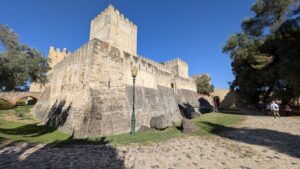 All that is left are the walls and fortifications of the central bastion. The city was a walled city, with rings of walls built in concentric circles away from the Castle. The Castle is now a great place to view city and surrounds. It was not destroyed by the earthquake as it was built on top of rock. Unlike most of Lisbon which is built over mud.
As we walked down the hill we saw the Lisbon Cathedral, commissioned to be built 1 year after Lisbon was captured by King Alfonso I. It was built in a Romanesque style. Opposite the cathedral is the Church of St Anthony, the patron saint of Lisbon. It is built on the site where he was born. As we walked further down the hill we went through an area with a lot of Fado Restaurants. Fado is a style of Street or working-class music famous in Lisbon. While it is being performed it is customary to remain silent as a show of respect for the music and the musicians. I will add more on this in tomorrow’s blog, we are going to a Fado Restaurant tonight.
At the bottom of the hill we came to the original settlement area of Lisbon, the Alfarma district. Here lots of natural springs and water sources were found, enabling settlement. We saw an old drinking Fountain for people and beside that one for animals. Back in the day, many drinking fountains were often restricted to people of certain social class, below which you couldn’t use it. We also saw an old Political Prison from the days under the rule of the dictatorship of Salazar, it has now been converted in to a museum of Liberty.
We got back in our car and drove along the foreshore and passed the huge Commercial Square, the largest square in the city, in the western part of the city. This is also called the Monument Section. It is home to the Belem Tower, Jeronimos Monastery and the Monument to the Discoveries, and also the home of the famous (and delicious) Portuguese Tart, “Pasteis de Belem”.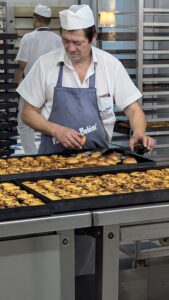
We got to see behind the scenes at the Pasteis de Belem, to see how the tarts are made. Apparently, they make around 20,000 units a day. There were very long queues of people wanting to try these tasty morsels. We got one each and sat in a park opposite to savour them. They were easily the best we have tried.
The Monument to the Discoveries celebrates the golden age of Portuguese exploration and colonisation. It features statues of many of Portugal’s most famous explorers and those that recorded the historic Expeditions. It’s very impressive.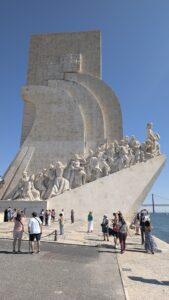 The forecourt to the Monument is tiled to look like waves, and at certain angles in makes flat ground look like it if full of depressions and rises.
The Jeronimos Monastery, is a very big impressive building that, like the Tower of Belem, survived the events of 1755. The monastery structure contains both a monastery and a church. In 1833 Portugal was secularised and the Monastery was closed. It was the monks from there that first began making the Pasteis de Belem. The recipe they used is still the same one used today.
The Tower of Belem is a 16th century fortification on the banks of the Targus River and served as the location for the embarkation and disembarkation for the Portuguese explorers. Unfortunately for us it was covered in scaffolding and tarps for restoration. Alongside the tower is a statue of a plane, commemorating the first flight across the Atlantic Ocean from Europe to Rio de Janeiro, made by 2 Portuguese pilots.
Crossing the Targus River here is the 25th of April Bridge, a huge twin deck bridge, named after the date of the revolution when the dictator Salazar was overthrown in 1974. On a hill on the far side of the river is a statue, “Christ the King”, inspired by the statue Christ the Redeemer in Rio.
This is such an interesting and relaxed feel city, we both felt it would be an easy city to stay in for a long time. But enough for now, Fado awaits us.
Subscribe to our blog
Search our site
Site Visit counter
Visits since 1 Feb 2020

1234,544 visits up to 31 Jan 2020Log in
Pages
- About this Site
- GregnDeb by Map
- 2006 England, Scotland and Italy
- 2007 Central Australian Outback
- 2007 – 2008 Antarctica and South America
- 2008 Vietnam & Cambodia July-Aug
- 2008 Great Ocean Road & Kangaroo Island Oct with G&J
- 2009 Around the World Apr-Aug
- 2009 Mallacoota, Wilsons Promontory and Halls Gap Oct
- 2010 North America & Alaskan Inside Passage Cruise
- 2011 Western Half of Australia Jul-Ag
- 2013 Carnival Spirit Pacific Cruise
- 2013 India
- 2015 Carnival Spirit Cruise
- 2015 Chile, Galapogas, Cuba, Mexico & USA
- 2016 Norfolk Island
- 2016 Eastern Australia Tour July to Sept
- 2018 Africa July
- 2018 China and Hong Kong in May
- 2018 New Zealand Adventures April
- 2019 England, Scotland, Iceland and Ireland May to Aug
- 2023 Greece, Croatia and England
- Short Breaks in Australia
- More Photos
- Our COVID-19 Life
- Our Travels 2006 to 2010
- 01. 2010 North America
- 02. 2010 Adelaide to Gosford to Sydney to Canberra to Adelaide
- 03. 2010 Australian Open Tennis Melbourne January
- 04. 2009 Around the World
- 05. 2009 Mallacoota, Wilsons Promatory and The Grampians
- 06. 2008 Great Ocean Rd, Kangaroo Is & Adelaide
- 07. 2008 Vietnam & Cambodia
- 08. 2007 – 2008 Antarctica and South America
- 09. 2007 Central Australian Outback
- 10. 2006 UK and Italy Aug & Sept
- 11. 2006–2009 Short Trips & Plans
- Useful Travel Info Sites
- Zero Hr COVID-19
- #01 November 2019 & January 2020 – The Novel Coronavirus begins and breaks out
- #02 February 2020 COVID-19 Spreads Globally
- #03 March 2020 COVID-19 It Spreads very widely
- #04 April 2020 COVOD-19 The world tries to deal with Covid-19
- #05 May 2020 COVID-19. A new “Normal”
- #06 June 2020 Covid-19 Things are getting worse
- #07 July 2020 Covid-19 Complacency is our greatest danger
- #08 August 2020 Covid-19 Globally No Better No Worse, Victoria from Good to VERY Bad
- #09 September 2020 Covid-19 Globally it’s getting Worse, Victoria is back on track.
- #10 October 2020 Covid-19 The Pandemic takes hold Globally
- #11 November 2020 Covid-19
- #12 December 2020 Covid-19 The End of 2020 – We have vaccines and the hope of a brighter 2021
- #13 January 2021 Covid-19 The start of a new year with promise
- #14 February 2021 Covid-19 The “New Normal” has become normal
- #15 March 2021 Vaccinations in Australia begin and so does the Global Third Wave.
- #16 April 2021 The Third Wave is continuing to grow.
- #17 May 2021 The Third Wave comes and goes, where now?.
- #18 June 2021 The “Third Wave” is over, but hello the Delta Variant!
- #19 July 2021 The Delta Variant has arrived and brought on a 4th Wave of Covid-19
- #20 August 2021 Covid-19 Same Same but Different, Delta Dominates
- #21 September 2021 We ride the 4th wave
- #22 October 2021 The Fourth Wave is over, what next?
- #23 November 2021 Looks like Omicron is riding the 5th wave
- #24 December 2021 And then there was Omicron
- #25 January 2022 The month of Omicron
- #26 February 2022 Omicron fades away
- #27 March 2022 Covid-19 Australia’s 6th Wave and a Global Steady State.
- #28 April 2022 Covid-19 is declining world-wide, but comes close to home
- #29 May 2022 The numbers of Covid-19 “reported” are continuing to decline
- #30 June 2022 The Pandemic has stabilised, or has it!!
- #31 July 2022 Another wave of Covid-19 washes over us.
- #32 August 2022 The decline of the Omicron Wave
- #33 September 2022 A Political End to the Pandemic
- #34 October 2022 Covid-19 Diary
- #35 November 2022 Covid-19 Diary
- #36 December 2022 The West Begins to Normalise as China sets Covid-19 free.
- #37 January 2023 Covid-19 Let’s look the other way, it might go away!
- #38 February 2023 Covid-19, Don’t mention it!
- #39 March 2023 Covid-19 Now Endemic
- Covid-19 Charts Jan 2022 to end April 2022