We were picked up at 9am and drove about 136km east to Evora, about a 75 min drive from Lisbon. The speed limit on the Tollway/highway was 120km/hr. Our driver today was John, and he will also be our driver for our trip up to Porto.
Our route east took us over the 25th April Bridge. Lisbon suburbs extend for about 40km from the centre of the city, it’s rural after that.
We passed a VW car manufacturing plant, the largest in Portugal, it employs about 10,000 workers.
Cork Oak tree farms were dotted all along either side of the highway. Cork takes 25 years to get to a 1st bark harvest. Unfortunately, the 1st harvest is not good quality. The next harvest is after 9 years further growth and then every 9 years after that. Cork bark is removed from just above ground level to about 1.0 to 1.5m up the trunk. You can tell recently harvested trees by the red colour of their trunks. Cork farms are randomly planted, not like an ordered orchard.
There were huge Stork nests everywhere, they seem to favour electricity transmission towers and other tall structures. They are protected birds and the nests can’t be disturbed.
We arrived in Evora, a UNESCO World Heritage City, located in the heart of the Alentejo region at around 10:20am, it is a walled city. The town square, Praça do Giraldo, is in the centre of the town and was a place of significant events during the Spanish/Portuguese Inquisition.
The inquisition began in Portugal in the Evora area, because of its proximity to Spain. The Inquisition was the investigation and subsequent prosecution of new converts to Christianity who had “embraced” Christianity (and apparently abandoned their old faith), to obtain the safety of citizenship/ residency of Portugal (& Spain), they were essentially Christians of convenience. These people were said to have been predominately Jews and some Moors. There were many atrocities committed in the name of Christianity in these times.
A bit up the hill from the square was an old Roman Temple ruin. The ruins were built in the 1st Century and likely dedicated to Emperor Augustus, though it has been falsely/commonly linked to Diana, the goddess of the hunt. The ruins now consist of a 4 sided structure that has columns along 3 of its sides. It looks impressive.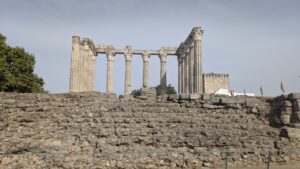
It stands next to the Evora Cathedral, officially known as the Basilica Cathedral of Our Lady of the Assumption was built between1186 and 1250 and is a blend of Romanesque, Gothic, Manueline, and Baroque styles. Its nave is 70m long, one of the longest in Portugal. It is the largest medieval cathedral in Portugal. It has wide cloisters with high arches and access to the roof via a spiral staircase of 135 steps. (they have installed a traffic light system for the very narrow staircase, but everyone seems to ignore it). The views of the roof and from the roof are both interesting architecturally and panoramic of the countryside. The Renaissance Organ inside is one of the oldest in Europe still housed in a Cathedral. The cathedral was a hub for the School of Évora, a centre of polyphonic music in the 16th and 17th centuries. There were Romanian beggars at the entrance to the church, a family all with cups outstretched and practiced woeful looks on their faces. (Our guide said they were professional beggars)
We then went to the Chapel of Bones that adjoins to the São Francisco Church. In the 16th century the plague decimated the population of Evora and the graveyard quickly filled to capacity. In the 17th century it was decided to “unbury” the skeletons to make room for new graves. To respect the remains they used the bones to cover the walls and columns of a chapel. An inscription above the entrance to the chapel reads in Portuguese “ NOS OSSOS QVE AQVI ESTAMOS PELOS VOSSOS ESPERAMOS” (or in English, “We the bones that are here are waiting for yours”). It was really interesting and skilfully done.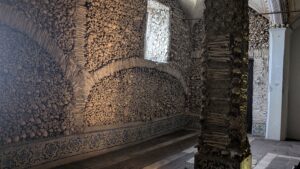 There were also two mummified bodies on display as well. Fascinating and respectful. After visiting the chapel we had a look inside the São Francisco Church it was attached to. It was built between 1480 and 1510, and it a good example of Gothic and Manueline architecture.
From there we went to a local restaurant “Restaurante REPAS” for lunch. We had cheeses and bread for starters, and shared Carne de Porco a Alentejana (Pork and Clams) for main. It was served with a healthy portion of locally made chips. (I guess you could call it a fancy Portuguese Pork, chips and gravy). It was very good.
We left Evora and went to the village of Arraiolos, home to a centre continuing the traditional methods for producing Arraiolos carpets. These carpets are hand stitched and can take months to produce. The craftsmanship of the women who work at the centre was stunning.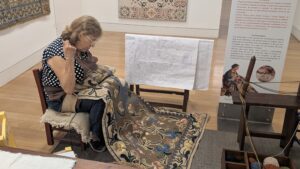 We gained a very good insight into what is unfortunately a dying art form.
We left there at about 2:30pm and drove back to Lisbon. We were expecting a day in the low to mid 30s today, instead we got high 20s with some rain. Gladly the rain came while we had lunch and on the drive back. So in the end the weather was very kind to us.
Subscribe to our blog
Search our site
Site Visit counter
Visits since 1 Feb 2020

1234,544 visits up to 31 Jan 2020Log in
Pages
- About this Site
- GregnDeb by Map
- 2006 England, Scotland and Italy
- 2007 Central Australian Outback
- 2007 – 2008 Antarctica and South America
- 2008 Vietnam & Cambodia July-Aug
- 2008 Great Ocean Road & Kangaroo Island Oct with G&J
- 2009 Around the World Apr-Aug
- 2009 Mallacoota, Wilsons Promontory and Halls Gap Oct
- 2010 North America & Alaskan Inside Passage Cruise
- 2011 Western Half of Australia Jul-Ag
- 2013 Carnival Spirit Pacific Cruise
- 2013 India
- 2015 Carnival Spirit Cruise
- 2015 Chile, Galapogas, Cuba, Mexico & USA
- 2016 Norfolk Island
- 2016 Eastern Australia Tour July to Sept
- 2018 Africa July
- 2018 China and Hong Kong in May
- 2018 New Zealand Adventures April
- 2019 England, Scotland, Iceland and Ireland May to Aug
- 2023 Greece, Croatia and England
- Short Breaks in Australia
- More Photos
- Our COVID-19 Life
- Our Travels 2006 to 2010
- 01. 2010 North America
- 02. 2010 Adelaide to Gosford to Sydney to Canberra to Adelaide
- 03. 2010 Australian Open Tennis Melbourne January
- 04. 2009 Around the World
- 05. 2009 Mallacoota, Wilsons Promatory and The Grampians
- 06. 2008 Great Ocean Rd, Kangaroo Is & Adelaide
- 07. 2008 Vietnam & Cambodia
- 08. 2007 – 2008 Antarctica and South America
- 09. 2007 Central Australian Outback
- 10. 2006 UK and Italy Aug & Sept
- 11. 2006–2009 Short Trips & Plans
- Useful Travel Info Sites
- Zero Hr COVID-19
- #01 November 2019 & January 2020 – The Novel Coronavirus begins and breaks out
- #02 February 2020 COVID-19 Spreads Globally
- #03 March 2020 COVID-19 It Spreads very widely
- #04 April 2020 COVOD-19 The world tries to deal with Covid-19
- #05 May 2020 COVID-19. A new “Normal”
- #06 June 2020 Covid-19 Things are getting worse
- #07 July 2020 Covid-19 Complacency is our greatest danger
- #08 August 2020 Covid-19 Globally No Better No Worse, Victoria from Good to VERY Bad
- #09 September 2020 Covid-19 Globally it’s getting Worse, Victoria is back on track.
- #10 October 2020 Covid-19 The Pandemic takes hold Globally
- #11 November 2020 Covid-19
- #12 December 2020 Covid-19 The End of 2020 – We have vaccines and the hope of a brighter 2021
- #13 January 2021 Covid-19 The start of a new year with promise
- #14 February 2021 Covid-19 The “New Normal” has become normal
- #15 March 2021 Vaccinations in Australia begin and so does the Global Third Wave.
- #16 April 2021 The Third Wave is continuing to grow.
- #17 May 2021 The Third Wave comes and goes, where now?.
- #18 June 2021 The “Third Wave” is over, but hello the Delta Variant!
- #19 July 2021 The Delta Variant has arrived and brought on a 4th Wave of Covid-19
- #20 August 2021 Covid-19 Same Same but Different, Delta Dominates
- #21 September 2021 We ride the 4th wave
- #22 October 2021 The Fourth Wave is over, what next?
- #23 November 2021 Looks like Omicron is riding the 5th wave
- #24 December 2021 And then there was Omicron
- #25 January 2022 The month of Omicron
- #26 February 2022 Omicron fades away
- #27 March 2022 Covid-19 Australia’s 6th Wave and a Global Steady State.
- #28 April 2022 Covid-19 is declining world-wide, but comes close to home
- #29 May 2022 The numbers of Covid-19 “reported” are continuing to decline
- #30 June 2022 The Pandemic has stabilised, or has it!!
- #31 July 2022 Another wave of Covid-19 washes over us.
- #32 August 2022 The decline of the Omicron Wave
- #33 September 2022 A Political End to the Pandemic
- #34 October 2022 Covid-19 Diary
- #35 November 2022 Covid-19 Diary
- #36 December 2022 The West Begins to Normalise as China sets Covid-19 free.
- #37 January 2023 Covid-19 Let’s look the other way, it might go away!
- #38 February 2023 Covid-19, Don’t mention it!
- #39 March 2023 Covid-19 Now Endemic
- Covid-19 Charts Jan 2022 to end April 2022