We were picked up by our driver, Alex. at 9:35 for our 1.5hr drive to Cordoba. The traffic was reasonably heavy getting out of Seville. It was an interesting drive up, there were olive plantations as far as the eye could see, and it looked like grain fields were being repurposed to olive groves, many new olive tree plantings.
Another thing we like is the constant reminder of the history of the land were are travelling in. The occasional old fortress, old churches and bell towers, crumbling very old farm houses/buildings, a constant reminder of why we travel.
It started raining about 30mins out from Cordoba. Grain cropping took over from olives as the main crop as we got closer to Cordoba. But there were lots of new olive tree plantings.
We were dropped off across the river from the old city at 11:20, to get to the old city we had to cross an old Roman bridge. 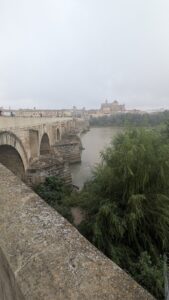
Speaking of guides, we arrived at the place we were meant to meet our guide a little before 11:30. A guide standing at the same place asked if I was Mike, she was there to take Mike on a tour. After a while we were chatting with her and Deb suggested we could be Mike and do the tour with her. She rang her office, apparently her group had gone off with our guide!!! So at 11:45 we set off with our new guide Saray. She had studied history and archaeology at Uni and had been working as a guide for 10 years, she sounded like our perfect guide.
We headed off and walked through the old Jewish Quarter, we always seem to start tours this way! Anyway, it was interesting as usual. The Quarter was fairly small, just large enough for 50 to 60 families, 200 to 300 people. We walked around and saw that old homes in the area were built around a central courtyard that always featured a garden/trees and a water feature of some kind, fountains or pool. The old city is a cat sanctuary, where the cats are protected by law. The city desexes them and the community looks after them. Saray said since this was introduced she hadn’t seen a mouse or rat in the old city. We saw very narrow alley ways, some adorned with plants and others that were dead ends that led to small courtyards that a small number of houses fronted, a security thing from the old days. All the streets in the old city are very narrow, making the use of cars the territory of the brave and foolish. Many cars and walls bare the scars of the daily dual. The Jews suffered persecution in 1591, they were accused of bringing the bubonic plague to the city. We saw a statue of Moshe ben Maimon aka Maimonides, considered one of the greatest Torah scholars of the medieval period. He was a doctor, philosopher, astronomer and rabbi. His medical works were ground breaking for the time.
We saw a statue of Mohamed Al Gafeoui, who in 1155 is credited with the first cataract surgery.
The street orange trees both in Seville and Cordoba are said to be bitter, good for jams and marmalade but not eating, they are easily distinguished from sweet orange trees by their double leaves.
We then headed to the jewel of the city and our tour, the famous Cordoba Mosque-Cathedral. It is called one of the world’s most exceptional monuments and a testimony to the ancient alliance of art and faith that occurred in the old city.
In the 8th century a mosque was built on the site of a former Visigothic Basilica by Adb al-Rahman I, in the 9th and 10th centuries successive rules expanded the mosque, and ornate features like the mihrab and the minaret. It became one of the largest and most beautiful mosques in the Islamic world. It also has a quirk to it, the original Mosque did not face Mecca, it was/is about 40 deg out of alignment, it points north/south! There are many theories as to why or how this occured, all are interesting.
In 1236, King Ferdinand III captured Cordoba and consecrated the Mosque as a Catholic Cathedral. He did this without disturbing the essential architecture of the building. At that time the mosque had over 1800 supporting columns and a capacity for around 40,000 worshippers.
In the 16th century, part of the near central area of the “mosque” was converted into a Renaissance style knave and choir, a more “traditional” looking church. 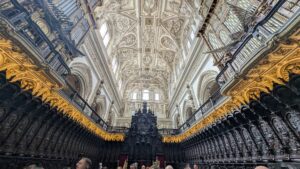 It was a blend of Gothic Baroque and Renaissance architecture with the original Islamic architecture. At this time the minaret was clad in stone, but it still retains all its original interiors.
The original mosque architecture featured prolific use of double arches between columns to strengthen the building, the double arches served the same purpose as flying buttresses do in medieval churches. 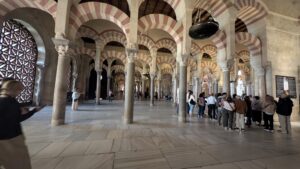 The mosque was built with a large degree of symmetry, with initially equal number of columns and corridors facing east/west and north/south, it gave the building a sense of grandeur and endlessness.
The Mosque-Cathedral has 60 Chapels, 4 of which are still in use today. Most of them were “sponsored” by wealthy local families. We were taken to one of the active Chapels and given a brief history of it. The first family to owned it back in the 13th century and adorned it with family shields and decorative tiles, the next owners took over in the 17th century and added an alter and shrine, finally the present owners took over the Chapel at the end of the 19th century and added family coats of arms. With each change of ownership all remains in the Chapel Vault had to be removed. Today, the current owners restrict the right to be entombed in the Chapel Vault to those of pure family blood line. On 8 Aug 2025 a fire broke out within the Mosque-Cathedral, it resulted in a portion of the roof collapsing and other damage. It still smells of fire. The cost of the repair has soaked up funds that were destined for other restorative works.
Saray left us inside the Mosque-Cathedral to continue exploring at our own pace.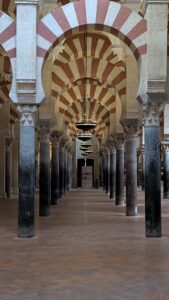 We had such a good time under her guidance.
We eventually left the Mosque-Cathedral and found a local place for a late lunch. I had Oxtail with potato and Deb had grilled squid. As with all other local food we have had, both meals were deliciously flavoursome.
After lunch we walked back through the old city, filled our water bottles from a fountain, 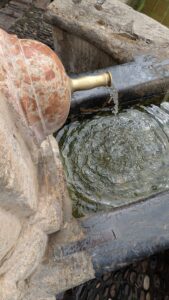 then walked back across the Roman bridge to our driver and went back to Seville.
After a bit of a rest we headed out, did a little shopping, got an Ice-cream and found the local laundry (for domestic things tomorrow), and that did us for the day.
Number of Views :159