OK stand back everyone, believe it or not, but we started our day with two consecutive church services!! Things you do on holiday.
Our day started with a 10am service in Capilla Real (Royal Chapel). Long story short, there are two ways to see this Chapel, go in as a tourist or go in to attend a service. You cannot take photos either way, so we opted for the service so we could experience it as a working Chapel. The chapel itself is a Renaissance style building and was built to house the sanctuary the tombs of Queen Isabella, Ferdinand III, Alfonso X, and other Castilian royalty, along with a venerated image of the Virgen de los Reyes, built in the years 1512 to 1517. The Gothic Cathedral was then built around the chapel in the second half of the 16th century. We were very lucky, we entered the chapel at sat towards the back, a bit before 10am they opened the gates into the sanctuary, the highly ornate part of the chapel that contains the tombs and alter. As everyone started to move inside we followed and got seats at the back. The service was performed by 5 priests assisted by alter buys (apparently alter boys these days are 40 to 50 year old men!). The music and singing for the service was pre-recorded, but it still added to the atmosphere. We both enjoyed the opportunity to see the chapel, without it being full of tourists.
We left the Royal Chapel at the end of the service, 11am, and walked around to the Cathedral, the service there started at 11am. We got in passed security no problem, and got a seat at the back. That put us about 75m from the alter, such a long way back. They had a woman leading the congregation in singing and we could see someone was actually playing the organ. The Cathedral is massive, it has many huge columns supporting the roof. 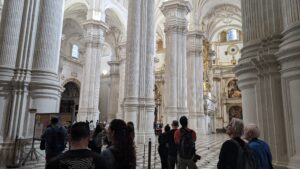 The Gothic section has a length of 126 m, a width of 76 m, and a central nave height of 36 m, 40 m at the crossing). The total height of the Giralda tower from the ground to the weather vane is 104.5 m. At the time is was built is surpassed the Hagia Sophia as the largest Cathedral in the world. We both enjoyed the singing and music, in such a big chamber it resonated. We left the service about halfway through, enough religion for one day!
From here we went back to our hotel to take stock before our tour in the afternoon.
Our tour in the afternoon took us to the 13th century Alhambra, a complex palace with breathtaking Islamic decor and beautifully landscaped gardens that literally took centuries and the input of 5 distinct historical influences to shape it into what we see today, an extraordinary palace complex that is unmistakably Islamic in design with subtle changes by Christian rules over the years.
Its most earliest fortifications date back to the 9th century, but its was the Islamic Nasrid Dynasty that made it into the Palace / Fortress we see today. Between the 9th and 15th century it was transformed into a Palace and palatine city.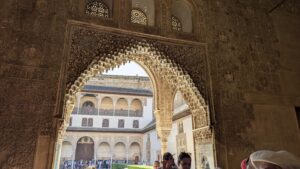 The Court of the Lions, Sala de los Abencerrajes, and Sala de las Dos Hermanas were all added in this time period. The Nasrid design was all about power, subtle but ever present, from the Mexuar (audience hall) to the Palacio de Comares (home to the Hall of Ambassadors) to the Palacio de los Leones with its centrepiece the Court of the Lions.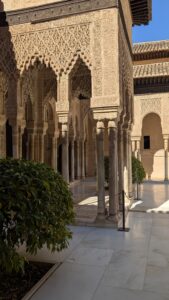
The entire complex is a tribute to Islamic design and art, with its ceramic tiling, woodwork and decoration. There are manicured gardens throughout and water is a common feature whether it be ponds, fountains, running water in open streams and the ever present sound of water everywhere. 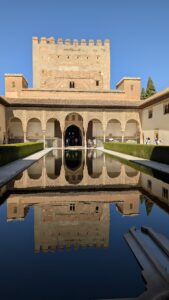
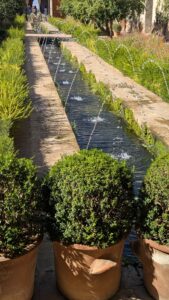 The gardens added the atmosphere of Moorish culture by providing a background of perfume. It was interesting to see how the Nazari monarchs moved the daily lives and living areas through the buildings dependent on the weather.
In 1492 the Nasrid dynasty was overthrown by the Christian Monarchs Ferdinand and Isabella, ending Muslim rule of Granada. The Alhambra became their Royal Court, and it is where Christopher Columbus was given their sponsorship for his voyage to the Americas.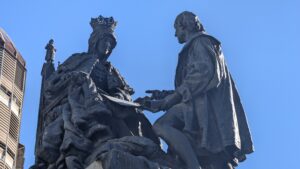 (it was actually for him to sail west to India, but he ran into the Americas instead). It became the Palace of Charles V in 1526, and he commissioned a Renaissance styled Palace, that was never completed, within the complex.
The Alhambra fell into disrepair in the 18th and 19th centuries. Napoleon’s forces damaged parts of it in 1812. A Romantic Revival attributed to the works of Washington Irving, specifically his “Tales of the Alhambra” that drew international attention to it and the start of restorative works.
The Alhambra received UNESCO World Heritage Site designation in 1984.
We have found a new interest/liking of Moorish Islamic buildings, they are much more conservative in design than the Christian churches and cathedrals of the same periods. The clean lines and symmetry are more relaxing than the busy intricacies of the Christian structures.
We moved from the buildings to the gardens, Deb’s special place. All of the gardens had formal design, and water was an intricate part. Hedges, archways, avenues, ponds and flower beds. You could feel the coolness the gardens added, and a sense of calm from the combination of gardens and water. A very relaxing way to finish our tour.
We walked back down the hill through forests to the city, it was about a 1.5km walk, and we enjoyed it. At the bottom of the hill we found a stated of Columbus being given his commission by the King, an interesting way to finish our explorations for the day.
Subscribe to our blog
Search our site
Site Visit counter
Visits since 1 Feb 2020

1234,544 visits up to 31 Jan 2020Log in
Pages
- About this Site
- GregnDeb by Map
- 2006 England, Scotland and Italy
- 2007 Central Australian Outback
- 2007 – 2008 Antarctica and South America
- 2008 Vietnam & Cambodia July-Aug
- 2008 Great Ocean Road & Kangaroo Island Oct with G&J
- 2009 Around the World Apr-Aug
- 2009 Mallacoota, Wilsons Promontory and Halls Gap Oct
- 2010 North America & Alaskan Inside Passage Cruise
- 2011 Western Half of Australia Jul-Ag
- 2013 Carnival Spirit Pacific Cruise
- 2013 India
- 2015 Carnival Spirit Cruise
- 2015 Chile, Galapogas, Cuba, Mexico & USA
- 2016 Norfolk Island
- 2016 Eastern Australia Tour July to Sept
- 2018 Africa July
- 2018 China and Hong Kong in May
- 2018 New Zealand Adventures April
- 2019 England, Scotland, Iceland and Ireland May to Aug
- 2023 Greece, Croatia and England
- Short Breaks in Australia
- More Photos
- Our COVID-19 Life
- Our Travels 2006 to 2010
- 01. 2010 North America
- 02. 2010 Adelaide to Gosford to Sydney to Canberra to Adelaide
- 03. 2010 Australian Open Tennis Melbourne January
- 04. 2009 Around the World
- 05. 2009 Mallacoota, Wilsons Promatory and The Grampians
- 06. 2008 Great Ocean Rd, Kangaroo Is & Adelaide
- 07. 2008 Vietnam & Cambodia
- 08. 2007 – 2008 Antarctica and South America
- 09. 2007 Central Australian Outback
- 10. 2006 UK and Italy Aug & Sept
- 11. 2006–2009 Short Trips & Plans
- Useful Travel Info Sites
- Zero Hr COVID-19
- #01 November 2019 & January 2020 – The Novel Coronavirus begins and breaks out
- #02 February 2020 COVID-19 Spreads Globally
- #03 March 2020 COVID-19 It Spreads very widely
- #04 April 2020 COVOD-19 The world tries to deal with Covid-19
- #05 May 2020 COVID-19. A new “Normal”
- #06 June 2020 Covid-19 Things are getting worse
- #07 July 2020 Covid-19 Complacency is our greatest danger
- #08 August 2020 Covid-19 Globally No Better No Worse, Victoria from Good to VERY Bad
- #09 September 2020 Covid-19 Globally it’s getting Worse, Victoria is back on track.
- #10 October 2020 Covid-19 The Pandemic takes hold Globally
- #11 November 2020 Covid-19
- #12 December 2020 Covid-19 The End of 2020 – We have vaccines and the hope of a brighter 2021
- #13 January 2021 Covid-19 The start of a new year with promise
- #14 February 2021 Covid-19 The “New Normal” has become normal
- #15 March 2021 Vaccinations in Australia begin and so does the Global Third Wave.
- #16 April 2021 The Third Wave is continuing to grow.
- #17 May 2021 The Third Wave comes and goes, where now?.
- #18 June 2021 The “Third Wave” is over, but hello the Delta Variant!
- #19 July 2021 The Delta Variant has arrived and brought on a 4th Wave of Covid-19
- #20 August 2021 Covid-19 Same Same but Different, Delta Dominates
- #21 September 2021 We ride the 4th wave
- #22 October 2021 The Fourth Wave is over, what next?
- #23 November 2021 Looks like Omicron is riding the 5th wave
- #24 December 2021 And then there was Omicron
- #25 January 2022 The month of Omicron
- #26 February 2022 Omicron fades away
- #27 March 2022 Covid-19 Australia’s 6th Wave and a Global Steady State.
- #28 April 2022 Covid-19 is declining world-wide, but comes close to home
- #29 May 2022 The numbers of Covid-19 “reported” are continuing to decline
- #30 June 2022 The Pandemic has stabilised, or has it!!
- #31 July 2022 Another wave of Covid-19 washes over us.
- #32 August 2022 The decline of the Omicron Wave
- #33 September 2022 A Political End to the Pandemic
- #34 October 2022 Covid-19 Diary
- #35 November 2022 Covid-19 Diary
- #36 December 2022 The West Begins to Normalise as China sets Covid-19 free.
- #37 January 2023 Covid-19 Let’s look the other way, it might go away!
- #38 February 2023 Covid-19, Don’t mention it!
- #39 March 2023 Covid-19 Now Endemic
- Covid-19 Charts Jan 2022 to end April 2022