We were picked up at 8am by our guide and driver and headed into the interior of the Island of Mallorca.
Mallorca is the largest of the Balearic Islands, it has an area of 3640 sq kms and its highest point is Puig Majorin, 1445m the Serra de Tramuntana Range. It has a population of about 1 million permanent residents, and has visits from about 4 million tourists a year. Tourism accounts for about 85% of the Island’s GDP. It get about 300 days of sunshine a year. The biggest crops grown are almonds, olives, citrus and carob, and a little wine. Porkies the main meat produced on the island, and they have a healthy seafood industry.
Some/many of the olive trees we saw were very old, up to 1000 years old. In the early times the romans, and others, had grafted good fruiting varieties of olive trees onto the very old trunks of wild olive trees. Those trees looked very impressive.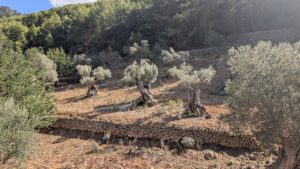
A feature of the countryside is dry stone walls, they are everywhere and are used extensively to tier the steep slopes.
The first stop on our tour today was a small village with cobblestone streets and stone houses called Vallemossa. Mallorca’s patron saint, Santa Catalina Thomàs was born there, tributes to her in the form of story tiles adorn most houses, there is a dedicated shrine to her and there is also a statue to her.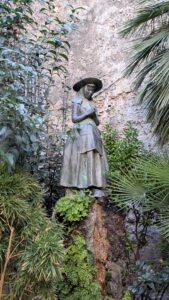
The most notable building in the village Royal Charterhouse of Valldemossa, a former monastery, is best known as the place where composer Frédéric Chopin 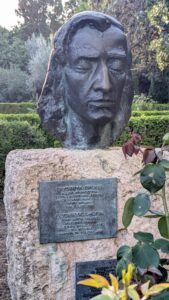 and writer George Sand (Amantine Lucile Aurore Dupin, a feminist ahead of her time) stayed in the winter of 1838–39. She documented their time in Mallorca in her book “A Winter in Majorca”. It has been said that the hardships they endured that winter inspired the couple to new heights in their endeavours. Chopin had gone to Mallorca to escape the European winter and seek relief for his worsening TB. He didn’t account for the bad weather on Mallorca that season.
We loved walking through the village, free of tourists. The houses and streets are essentially unchanged from the 18th and 19th centuries (except for the very visible electric wires that are run in a ramshackle nature on the outside of the buildings). The cobblestone streets, the mule tie-up rIngs by the front doors, the stone buildings with their green shutters. 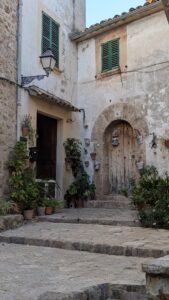 The unfinished monastery that was resumed by the state as part of the inquisition, the Royal Palace that externally is essentially unchanged, and it was quiet with almost empty streets. It’s so good when you’re ahead of the tourist coaches. We left just as the first coach in town began to unload the hordes.
We set off in the direction of Soller, with a brief photo stop at Mirador de sa Foradada. This is one of Mallorca’s most iconic viewpoints. It gets its name (“Sa Foradada” meaning “the pierced one,”) from the 18-meter hole in the rocky promontory that is a local landmark. 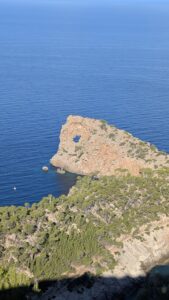 There is a large reception venue at the site that was once the residence of an Arch Duke who once owned a large portion of the coast in the area, it is said they charge 5000 euro an hour for use of the venue.
Outside the venue was a carob tree with pods still on it. Our guide Magdalena, told us that in ancient times the romans used carob seeds as a standard weight measure for the weight of gold. This is where the term carat comes from, as in 24 carat gold. Interesting and a quick fact check shows this is true according to my AI buddy.
From there we drove to Soller, first to the Port of Soller. It is one the only safe ports/harbour on the north coast of Mallorca. It was used as a shipping point for the citrus industry in Soller In the 29th century. A tramway was built between Soller and Port Soller, opening in 1913, this helped the Port evolve into Mallorca first tourist resort.
We then went up to Soller, in the shadow of Puig Majorin. Soller was known as The Valley of Citrus in 19th century and had a very profitable trade in citrus, particularly with France. This was the source of funds for many grand homes, public buildings and the1911 Ferrocarril de Sóller scenic railway that connects Soller with Palma.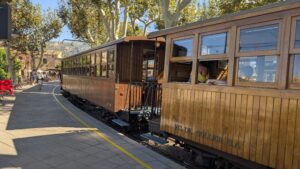
Soller also has a large church, with a facade designed by one of the students of Gaudi, Joan Rubio, The Church of St Bartomeu (1236). The church has undergone a lot of changes in its history. from an original Romanesque– Gothic church to today’s Baroque interior and the Neo-Gothic Modernist facade of today. It’s not the typical over the top Baroque style inside, the main Alter area is Baroque 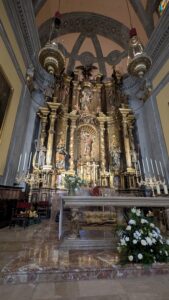 as are a few of the chapels, but the remainder of the church is understated. Its main stained glass windows were underwhelming but one on the side was impressive in its detail.
We then went up to the train station and caught the Vintage train back to Palma. We sat in the First Class carriage, leather seats and everything!!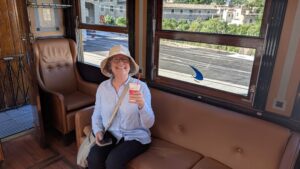 It was an enjoyable ride back to Palma at a leisurely 27kph. The train passed through 13 tunnels, the longest of which was 2.8km. It gave us a different view of the towns and countryside we had driven through on the way up.
We got to Palma around 1:15pm. We said good bye to Magdalena and walked to Mercat de Olivar, Palma’s main fresh produce markets. We walked around and took in all the food. I love the “walls” of Jamon in the delicatessens, the weird, wonderful and different seafood on offer,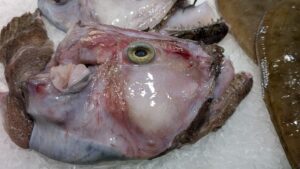 all the fresh fruit and vegetables, and the cheeses and small goods, so much great food!
We decided to have Variado Grande for lunch. We had to wait our time for a spot at the counter. It was worth the wait. Magdalena had suggested this for lunch, she said it was a very local thing to have, a bit like and lot of different tapas, but all piled up on one plate! 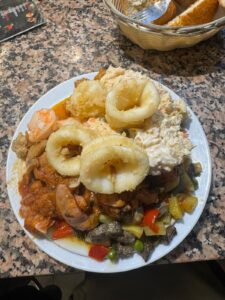 It was very tasty, something you probably would never order without some i side knowledge.
We walked back to our hotel the Ingress way, and discovered many more interesting bits of this city. We got back around 3pm.
I went out to play a bit more Ingress just after 4pm, and finished up down by the river and the cathedral. It’s enormous and definitely on our path tomorrow.
We don’t know how, but the aircraft carrier that was in the bay outside our window left without us noticing!!
The end of another really interesting day. Tomorrow we are left to our own resources, so it will be a leisurely start to the day.
Subscribe to our blog
Search our site
Site Visit counter
Visits since 1 Feb 2020

1234,544 visits up to 31 Jan 2020Log in
Pages
- About this Site
- GregnDeb by Map
- 2006 England, Scotland and Italy
- 2007 Central Australian Outback
- 2007 – 2008 Antarctica and South America
- 2008 Vietnam & Cambodia July-Aug
- 2008 Great Ocean Road & Kangaroo Island Oct with G&J
- 2009 Around the World Apr-Aug
- 2009 Mallacoota, Wilsons Promontory and Halls Gap Oct
- 2010 North America & Alaskan Inside Passage Cruise
- 2011 Western Half of Australia Jul-Ag
- 2013 Carnival Spirit Pacific Cruise
- 2013 India
- 2015 Carnival Spirit Cruise
- 2015 Chile, Galapogas, Cuba, Mexico & USA
- 2016 Norfolk Island
- 2016 Eastern Australia Tour July to Sept
- 2018 Africa July
- 2018 China and Hong Kong in May
- 2018 New Zealand Adventures April
- 2019 England, Scotland, Iceland and Ireland May to Aug
- 2023 Greece, Croatia and England
- Short Breaks in Australia
- More Photos
- Our COVID-19 Life
- Our Travels 2006 to 2010
- 01. 2010 North America
- 02. 2010 Adelaide to Gosford to Sydney to Canberra to Adelaide
- 03. 2010 Australian Open Tennis Melbourne January
- 04. 2009 Around the World
- 05. 2009 Mallacoota, Wilsons Promatory and The Grampians
- 06. 2008 Great Ocean Rd, Kangaroo Is & Adelaide
- 07. 2008 Vietnam & Cambodia
- 08. 2007 – 2008 Antarctica and South America
- 09. 2007 Central Australian Outback
- 10. 2006 UK and Italy Aug & Sept
- 11. 2006–2009 Short Trips & Plans
- Useful Travel Info Sites
- Zero Hr COVID-19
- #01 November 2019 & January 2020 – The Novel Coronavirus begins and breaks out
- #02 February 2020 COVID-19 Spreads Globally
- #03 March 2020 COVID-19 It Spreads very widely
- #04 April 2020 COVOD-19 The world tries to deal with Covid-19
- #05 May 2020 COVID-19. A new “Normal”
- #06 June 2020 Covid-19 Things are getting worse
- #07 July 2020 Covid-19 Complacency is our greatest danger
- #08 August 2020 Covid-19 Globally No Better No Worse, Victoria from Good to VERY Bad
- #09 September 2020 Covid-19 Globally it’s getting Worse, Victoria is back on track.
- #10 October 2020 Covid-19 The Pandemic takes hold Globally
- #11 November 2020 Covid-19
- #12 December 2020 Covid-19 The End of 2020 – We have vaccines and the hope of a brighter 2021
- #13 January 2021 Covid-19 The start of a new year with promise
- #14 February 2021 Covid-19 The “New Normal” has become normal
- #15 March 2021 Vaccinations in Australia begin and so does the Global Third Wave.
- #16 April 2021 The Third Wave is continuing to grow.
- #17 May 2021 The Third Wave comes and goes, where now?.
- #18 June 2021 The “Third Wave” is over, but hello the Delta Variant!
- #19 July 2021 The Delta Variant has arrived and brought on a 4th Wave of Covid-19
- #20 August 2021 Covid-19 Same Same but Different, Delta Dominates
- #21 September 2021 We ride the 4th wave
- #22 October 2021 The Fourth Wave is over, what next?
- #23 November 2021 Looks like Omicron is riding the 5th wave
- #24 December 2021 And then there was Omicron
- #25 January 2022 The month of Omicron
- #26 February 2022 Omicron fades away
- #27 March 2022 Covid-19 Australia’s 6th Wave and a Global Steady State.
- #28 April 2022 Covid-19 is declining world-wide, but comes close to home
- #29 May 2022 The numbers of Covid-19 “reported” are continuing to decline
- #30 June 2022 The Pandemic has stabilised, or has it!!
- #31 July 2022 Another wave of Covid-19 washes over us.
- #32 August 2022 The decline of the Omicron Wave
- #33 September 2022 A Political End to the Pandemic
- #34 October 2022 Covid-19 Diary
- #35 November 2022 Covid-19 Diary
- #36 December 2022 The West Begins to Normalise as China sets Covid-19 free.
- #37 January 2023 Covid-19 Let’s look the other way, it might go away!
- #38 February 2023 Covid-19, Don’t mention it!
- #39 March 2023 Covid-19 Now Endemic
- Covid-19 Charts Jan 2022 to end April 2022