We left our hotel this morning and walked to meet our guide out in front of the town hall, did I mention that when we left our hotel it was dark and raining, it was 9:40am.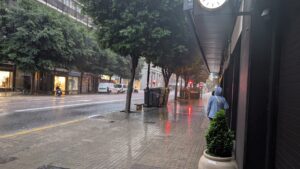
To set the scene we need a little history.
Valencia was founded by the Romans back in 138BC, at that time it was called Valentia Edetanorum. Even today there is still evidence of their presence here, particularly in the roads (eg Sant Vicent Martir- a long straight road that leads out of the city). After the fall of the Romans the city was ruled by the Visigoths, then became a flourishing city under the rule of the Muslims in the 8th century. Christians led by King James V captured the city in 1238 and it became part of the Crown of Aragon. In the 15th and 16th centuries it was a major trade and cultural hub which saw the city have its Golden Age. The city suffered through the 18th and 19th centuries due to the War of Spanish Succession and invasion by the forces of Napoleon. The 20th century saw the city’s industrial sector grow and the commencement of urban expansion. In 1957 the main river that ran through Valencia, the Turia River, flooded. Torrential rain saw it break its banks flooding Valencia in two separate waves in a 12hr period. The flooding was said to be 2 to 3 stories high/deep. Over 80 people died and there was massive property damage. In the aftermath of the floods a major project was undertaken to divert the course of the river and reroute it south of the city. The old riverbed was transformed into the Turia Gardens. In 2020 Valencia experienced a major urban fire the displaced many residents and caused widespread damage. This caused a major rethink in the urban planning of Valencia. The city was flooded again in 2024 when rain amounting to over 300 litres per square meter fell on the city, causing widespread flooding and damage.
The old city of Valencia was a walled city, with a wall of about 4km surrounding the city. The wall had 12 gates, of which only two survive today, one from the 14th century and one from the 15th century. The area that was surrounded by the wall is known as the old city. The wall was taken in the 19th century to allow urban expansion.
While much of the old city has been preserved, the new areas of urban growth have been driven by developers, and as a result the architecture is sadly lacking continuity and “class”. Unfortunately, some areas of the old city have suffered this type of redevelopment, spoiling some of its character.
Back to our tour, we started off in front of the town hall, looking out over a vast square, Placa de l’Ajuntament, surrounded by (mostly)beautiful buildings. At the end of one street we could see the old train station beyond which is the Valencia Bullring. We saw the Bank of Valencia building an orange coloured building with vast amounts of mosaic tiles on its facade.
We walked to the Central Markets, Mercat Central. Along the way we walked along narrow streets flanked by stylish buildings all with wrought iron clad balconies, and no two buildings ever looked the same. One similarity between them was the use of Mediterranean Pine for the large often ornate and always commanding doors that gave entrance to the buildings.
The markets area house within a 1928 building with brick frontages and a huge clear span interior. Markets have been held at this location since the middle ages. There are over 300 shops inside selling fresh produce of every kind. It is the largest market of its type in Europe. Many of the shops gave the providence of their goods, encouraging the idea of buy local and knowing where your food comes from. It was a great atmosphere and full of life and colour. We love markets like this.
Next it was onto the Lonja de la Seda, (the Valencia Silk Market). A large gothic style building built in the 15th century as a place for the wholesale trade of goods such as silk, textiles, luxury goods, and occasionally agricultural products.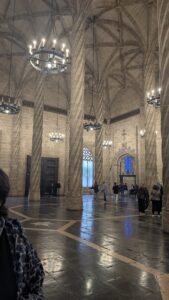 There were no contracts used at these markets, business was done by handshake agreements. The market continued trading at this location until 1986. Our guides grandmother first business woman at the market. It was a interesting building with spiral columns supporting the roof of the market hall, next to the trading hall was a bank room, where the deals were concluded and above the bank room was a tower, accessed through a self supporting spiral staircase.
It was then time to visit the Cathedral. On the way to the Cathedral we walked through “The Round” Square. Yes, a circular open space called a square called Plaza Redonda. 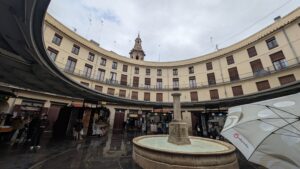 It now is home to craft stalls, tapas bars, cafes and has an historic 19th century fountain in the middle of it.
We got to the Cathedral, or more properly, the Metropolitan Cathedral–Basilica of the Assumption of Our Lady of Valencia (Iglesia Catedral-Basílica Metropolitana de la Asunción de Nuestra Señora de Valencia), commonly referred to as Valencia Cathedral (Catedral de Valencia) and there was a very long line waiting to get in. Oh the joy of fast track queue jumping with a great local guide. We were in within minutes.
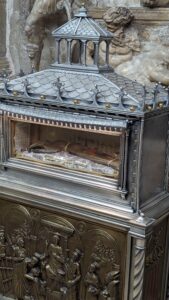
The Cathedral was build on the site of a mosque that was built on the site of an ancient roman temple. While the Cathedral is essentially a gothic styled building, because it took over 700 years to be completed, it also has elements of many other styles, such as Romanesque and Baroque. The main building is definitely Gothic, but the alter area is unmistakably Baroque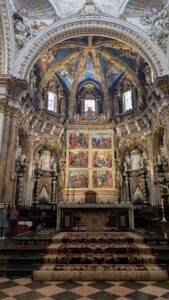 , with all its lavish decoration and extensive use of gold finishes. Behind the main alter is stored, on display, a relic of St Vincent. They have part of his right arm on display, it looks mummified.
 In the Chapel of the Holy Chalice (Capilla del Santo Caliz) they have The Holy Chalice (Holy Grail) – a dark agate cup mounted on a gold base with handles – it is believed by many to be the cup used at the last supper! (I couldn’t see it, but here is a picture of the Chapel, see if you can find it). There are 20 chapels in the Cathedral, all of which look to be actively used. There were lots of tourists inside the Cathedral, so there was no chance of getting a feel for the space.
After we left the Cathedral our guide took us to a central location and we said good byevto her, it had been an interesting time with her.
It was passed lunch time, so we walked back to the Central Market to get some lunch. We bought some nuts for snacks and a couple of bananas for later. We had spotted a place that sold tapas (small serves of numerous things) so we went there. We finished up getting Jamon in a crusty roll each and a tray of calamari to share. I can see we are going to have to fing a good source of Jamon when we get home. We sat outside (yes, the rain had cleared for a while) and ate lunch.
It was time to put our feet up, so we walked back to our hotel, calling in to take a few pictures of the Porta de la Mar, a large monument that stands at the site of one of the old city gates. It has a design similar to Roman Triumphal Arches and is a memorial to those who died in the Spanish Civil War (1936-39).
We had a very interesting day, we were both glad the tour went ahead despite the rain.
And don’t forget to have a look here:
https://www.facebook.com/Greganddebstravelblog?mibextid=ZbWKwL
