https://www.facebook.com/Greganddebstravelblog?mibextid=ZbWKwL
#Retiredlyf
We met Laura our guide and our driver at our hotel at 9am. It’s Gaudi Day!
Antoni Gaudí (1852–1926), was an architect who embraced the Catalan Modernisme Movement (a branch of Art Nouveau). His signature designs used organic forms, vibrant colours, mosaics, and textures. He Integrated ceramics, stained glass, and wrought iron into innovative structural forms using paraboloids, hyperboloids, and helicoids. His work is striking and often polarising, often described as living sculpture. Above all it is always unmistakably Gaudi.
So I guess if you’re going to have a Gaudi day, you should dive in at the deep end, and that is exactly what we did.
Basílica i Temple Expiatori de la Sagrada Família, or as it is more commonly known, The Sagrada Família is Gaudí’s work of a lifetime and has been called his masterpiece. 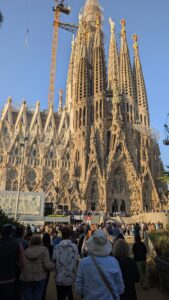 Surprisingly, Gaudi was not the original architect on the project, after the first architect left the project following a dispute, a young 31 year old Antoni Gaudi was given the project in 1893, one year into the build. The initial design was for a Neo-Gothic Cathedral, but this was not Gaudi, so he put his stamp on the project. When he took over, only some of the foundations had been laid. His first assignment was to build a Parish Chapel, this was the first part of the project completed in1890. This Chapel still remains and now serves as both the Parish Chapel and the Crypt. Gaudi is entombed in the Crypt.
Gaudi transformed the design to a unique blend of Gothic and Art Nouveau. His vision for the design was based on a principle of enjoying god through nature. All the internal columns are tree-like structures, and the type of arches he used allowed an immense amount of light into the Cathedral.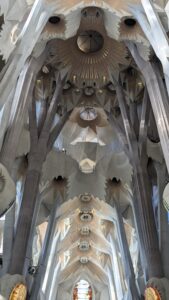 There are vast arrays of stained glass windows throughout the building. Many of the spires of the building have fruit or produce sitting on top of them, there are tree designs built into the facade. The dominant feature of the facade is sculptures depicting the life and times of Jesus. From just before he was born, to the days of his crucifixion and resurrection. It is a complicated detailed design, but it has clarity and the individual elements are easily seen. Once the central spire, the Tower of Jesus Christ, is completed it will reach a height of 172.5 meters, making it the tallest church in the world.
Inside the cathedral is all about light. The stained glass windows are coloured differently from greens and blues for those that get the morning light to reds and oranges for those that get the afternoon sun.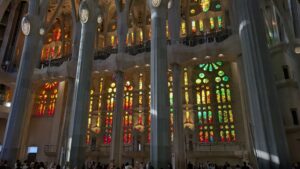 The windows also carry the names of saints and places of pilgrimage. Australia’s Saint Mary McKillop (Saint Mary of the Cross) is named in the first windows on the left as you enter via (the yet to be finished/built) front door.
Although building commenced in 1882, the work is still ongoing, with completion expected in 2026. This will mark 100 years since Gaudí’s death. The locals hope is that the Pope will be the one to formally consecrate the building.
To say this building is striking and imaginative might be an understatement, but its the best I’ve got.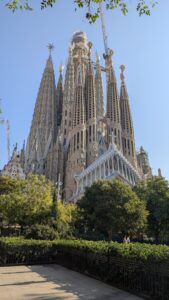
To continue our Gaudi quest we drove up to the hills overlooking Barcelona to Park Guell. This park started life as a housing project, but after it failed to attract buyers, the land was given over to the City. Gaudi was given a commission to integrate architecture with nature, heritage did this using organic forms and local materials, and created a layout of winding paths, terraces and viaducts that lend into the hillside. 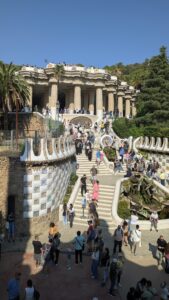 He used striking elements of his Catalan Modernist style incorporating colourful mosaics, large structural statements along with endless use of curves. The park became public space in the year he died and was later given UNESCO recognition.
We left Park Gruell and did a drive by Casa Batllo, we had seen this building yesterday, and currently it is closed to visitors. This building was a renovation project Gaudi took on after the owners wanted a home that reflected their status in the community. Gaudi completely restyled both the facade and interior of the building. The external facade covered in mosaics tiles of green, blue and tan hues, and unique balustrades on each balcony.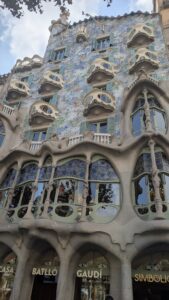
Next we drove onto La Pedrera, or Cassa Mila, built between 1906 and 1912. This is a pair of buildings of 9 levels. Gaudi designed the buildings to have no load bearing walls. An inner steel structure allowed him flexibility in design. The main residence was a sprawling 1200+ square meter apartment on The Principal Floor, or Noble Floor (the 1st floor) the next four floors were divided into 4 apartments of 300+ square meters, these were followed by an attic and then a rooftop terrace.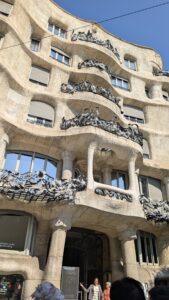
The buildings had central courtyards that extended a void all the way to the roof, enhancing the use of natural light into the buildings. Gaudi also incorporated a garage into the structure, to allow the parking of automobiles.
While there are Gaudi touches all through the building by the way of the use of light, decorate flourishes and flow between to rooms, the standout features of the building are its facade of stone that waves and rolls together with the wrought iron balcony and wi dow finishes that mimic natural forms, and its rooftop. The rooftop features Gaudi’s iconic chimneys, ventilation shafts and its legendary Guardians of the Rooftop.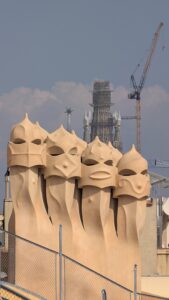 In a delightful twist, you can see the spires of the Sagrada Família from the rooftop.
We said goodbye to our guide after this and walked back to our hotel. It was a big interesting.
