We woke at 8am! Normally we would be high fiving, but today we were being picked up at 9am! This meant we were a “little” rushed, but we made it with minutes to spare.
Fernando, our driver met us in the lobby and told us Luis, our guide was running a little late due to some unexpected issues, we drove down to a Metro Station stop and then drove around for a while until he appeared. We were on our way to start our day by 9:25am.
Some fun facts to start this blog.
Lisbon is a light city due to stone used in building, Porto is dark for the same reason, different rocks.
The marque who rebuilt Lisbon was/is a very disliked as a person but his work in rebuilding Lisbon is undeniably remarkable.
The Lisbon aqueduct was finished just prior to the 1755 earthquake. It survived the earthquake. It has the highest gothic arch in the world. It was used until the 1960s to help with Lisbon’s historical water shortage issues.
Now for today. We headed west to Sintra, the by-gone summer playground/refuge for the monarchy and the wealthy. Sintra has relatively high humidity but its closeness to the coast keeps it cool.
We drove up to Pena Palace, (Palácio da Pena) it is an iconic landmark and fine example of romanticist architecture perched on Sintra’s highest hill. It stands out from the surrounding area not only because of its location at the highest point in the district, but for its vibrant colours and fairy-tale eclectic design. 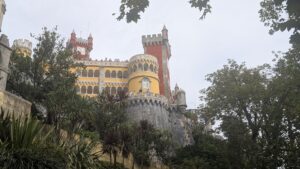 It is now a museum, more or less a time capsule marking the time near the end of the Portuguese Monarchy. We toured the outside of the Palace and also through the Royal rooms within. It was interesting to see their daily use rooms, from offices (for both King & Queen), to dining rooms, dressing rooms, bedrooms, etc.
The Palace has an interesting history, it started ”life” as a chapel that was expanded into a Monastery. The Monastery was severely damaged in the 1755 earthquake, leaving it as a ruin. In 1838, King Ferdinand II, acquired the site after becoming enchanted by the ruins. He had the Monastery transformed into a Palace, blending a rich diversify of Gothic, Moorish, Manueline and Renaissance styles into his own Romanticist vision. 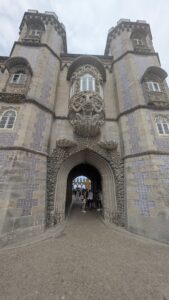
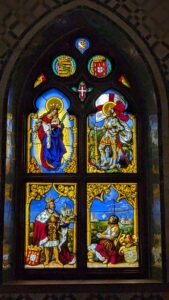 The Palace was recognised as part of the UNESCO World Heritage Site of Sintra’s Cultural Landscape in 1995. Today the Palace is a very popular tourist destination.
We were amused at the definition of Romanticism our guide gave us, he said it was orderly but wild at the same time. (That describes Deb pretty well )
We left the Palace at around d 12:20pm and had a walk through historic Sintra town. The town was established to service the needs of the Royal, rich and famous who lived in the area. It was an interesting stroll. We stopped off to sample two of the areas iconic “ foods”. First we called into Piriquita, established in 1862, and sampled their Travesseiro de Sintra (a pillow pastry stuffed with a mix of sugar egg yokes, water and cinnamon) and their Queijades (a thin crisp tart filled with a mix of cheese, eggs, flour, sugar, butter & cinnamon). Both were interesting, we enjoyed the pastry, but the fillings left us undecided. Next we dropped into Bar do Binho – The House of Port – est 1927. Here we tried a nip of Ginja (sweet & sour cherry liqueur) served in a fine 70% dark chocolate cup. Deb initially didn’t want to try one, but once chocolate was mentioned quickly changed her mind. Local etiquette says you sip the liquor 3 times then eat the chocolate. At the same time, we both put the whole thing in our mouth!! It was very tasty.
We then headed to Roca Cape, the most westerly point of mainland Europe.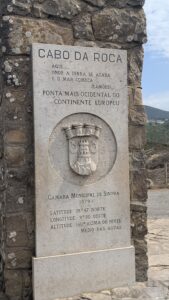 (It was pointed out that Portugal also lays claim to the overall most westerly point of Europe, Monchique Islet in the Azures) There is a Monument on the point marking the location and its significance, there is also a Lighthouse. We got pictures!!
We then drove down the coast in the direction of Casais and stopped for lunch at Restaurante O Faroleiro. We had a whole red snapper cooked Portuguese style. It was delicious and came with potato and onion, cooked in its own juices. We washed it down with a glass of Vinho Verde (which translates to green wine, from the green pastures of the Portuguese North West)
After lunch we drove down to Casais, described in our tour notes as “a quaint fishing town”. This it was definitely not. Think more the holiday/beach house location of the rich and famous. 5+ Star Resorts abounded, mansions everywhere and luxury Apartments. Not our sort of holiday spot, all glitz and glamour without substance. We got dropped off at the old Citadel and walked along the foreshore. It was awash with tourists.
After our walk we got back in the car and drove back to Lisbon along the coast road by the Tagus River. We had a very enjoyable day.
Subscribe to our blog
Search our site
Site Visit counter
Visits since 1 Feb 2020

1234,544 visits up to 31 Jan 2020Log in
Pages
- About this Site
- GregnDeb by Map
- 2006 England, Scotland and Italy
- 2007 Central Australian Outback
- 2007 – 2008 Antarctica and South America
- 2008 Vietnam & Cambodia July-Aug
- 2008 Great Ocean Road & Kangaroo Island Oct with G&J
- 2009 Around the World Apr-Aug
- 2009 Mallacoota, Wilsons Promontory and Halls Gap Oct
- 2010 North America & Alaskan Inside Passage Cruise
- 2011 Western Half of Australia Jul-Ag
- 2013 Carnival Spirit Pacific Cruise
- 2013 India
- 2015 Carnival Spirit Cruise
- 2015 Chile, Galapogas, Cuba, Mexico & USA
- 2016 Norfolk Island
- 2016 Eastern Australia Tour July to Sept
- 2018 Africa July
- 2018 China and Hong Kong in May
- 2018 New Zealand Adventures April
- 2019 England, Scotland, Iceland and Ireland May to Aug
- 2023 Greece, Croatia and England
- Short Breaks in Australia
- More Photos
- Our COVID-19 Life
- Our Travels 2006 to 2010
- 01. 2010 North America
- 02. 2010 Adelaide to Gosford to Sydney to Canberra to Adelaide
- 03. 2010 Australian Open Tennis Melbourne January
- 04. 2009 Around the World
- 05. 2009 Mallacoota, Wilsons Promatory and The Grampians
- 06. 2008 Great Ocean Rd, Kangaroo Is & Adelaide
- 07. 2008 Vietnam & Cambodia
- 08. 2007 – 2008 Antarctica and South America
- 09. 2007 Central Australian Outback
- 10. 2006 UK and Italy Aug & Sept
- 11. 2006–2009 Short Trips & Plans
- Useful Travel Info Sites
- Zero Hr COVID-19
- #01 November 2019 & January 2020 – The Novel Coronavirus begins and breaks out
- #02 February 2020 COVID-19 Spreads Globally
- #03 March 2020 COVID-19 It Spreads very widely
- #04 April 2020 COVOD-19 The world tries to deal with Covid-19
- #05 May 2020 COVID-19. A new “Normal”
- #06 June 2020 Covid-19 Things are getting worse
- #07 July 2020 Covid-19 Complacency is our greatest danger
- #08 August 2020 Covid-19 Globally No Better No Worse, Victoria from Good to VERY Bad
- #09 September 2020 Covid-19 Globally it’s getting Worse, Victoria is back on track.
- #10 October 2020 Covid-19 The Pandemic takes hold Globally
- #11 November 2020 Covid-19
- #12 December 2020 Covid-19 The End of 2020 – We have vaccines and the hope of a brighter 2021
- #13 January 2021 Covid-19 The start of a new year with promise
- #14 February 2021 Covid-19 The “New Normal” has become normal
- #15 March 2021 Vaccinations in Australia begin and so does the Global Third Wave.
- #16 April 2021 The Third Wave is continuing to grow.
- #17 May 2021 The Third Wave comes and goes, where now?.
- #18 June 2021 The “Third Wave” is over, but hello the Delta Variant!
- #19 July 2021 The Delta Variant has arrived and brought on a 4th Wave of Covid-19
- #20 August 2021 Covid-19 Same Same but Different, Delta Dominates
- #21 September 2021 We ride the 4th wave
- #22 October 2021 The Fourth Wave is over, what next?
- #23 November 2021 Looks like Omicron is riding the 5th wave
- #24 December 2021 And then there was Omicron
- #25 January 2022 The month of Omicron
- #26 February 2022 Omicron fades away
- #27 March 2022 Covid-19 Australia’s 6th Wave and a Global Steady State.
- #28 April 2022 Covid-19 is declining world-wide, but comes close to home
- #29 May 2022 The numbers of Covid-19 “reported” are continuing to decline
- #30 June 2022 The Pandemic has stabilised, or has it!!
- #31 July 2022 Another wave of Covid-19 washes over us.
- #32 August 2022 The decline of the Omicron Wave
- #33 September 2022 A Political End to the Pandemic
- #34 October 2022 Covid-19 Diary
- #35 November 2022 Covid-19 Diary
- #36 December 2022 The West Begins to Normalise as China sets Covid-19 free.
- #37 January 2023 Covid-19 Let’s look the other way, it might go away!
- #38 February 2023 Covid-19, Don’t mention it!
- #39 March 2023 Covid-19 Now Endemic
- Covid-19 Charts Jan 2022 to end April 2022