Some facts about Madrid
The city of Madrid has a population of about 3 million, greater Madrid around 7 million.
Madrid became the capital of Spain in 1561
Our day began with a half day tour of Madrid city. Our guide, Mari Luz, took us straight up to Plaza Mayor.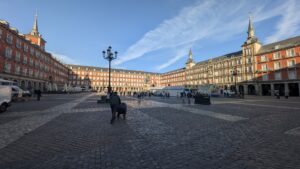
There we were given a quick history of Madrid.
In the 9th century it was an Islamic military outpost called Majrit under Muhammad I of Córdoba. In 1083 to 1085 it was conquered Christian forces and became part of the Crown of Castile. It remained a small village throughout the middle ages. In 1561, King Philip II moved the royal court to Madrid, making it the defacto Capital. The Habsburg (1516-1700) and Bourbon (1700 to present) eras mark two distinct dynastic periods that shaped the city’s architecture, culture, and political significance. The Habsburg era saw Madrid become the Spanish capital and the city flourish in Spain’s Golden Age, with cultural icons like Velázquez and Cervantes, and Plaza Mayor and the Royal Monastery of El Escorial were built. The end of this era triggered the War of the Spanish Succession. The Bourbon Era began with Philip V, the first Bourbon king of Spain. The Bourbons modernized Madrid’s infrastructure with major urban reforms, including street lighting, sewage systems, and neoclassical architecture. The Royal Palace of Madrid and Puerta de Alcalá are iconic Bourbon contributions.
Culturally, Madrid became a hub for arts, politics, and intellectual life in the 19th and 20th Centuries . It witnessed major events like the Spanish Civil War and the rise of Franco’s dictatorship. A countercultural explosion of music, art, and freedom followed Spain’s transition to democracy in the 1980’s, redefining Madrid’s identity. Plaza Mayor is a huge public square totally enclosed by 5 storey buildings of the early 17th century and later reconstructed after a fire to 3 storeys in the 18th century. Over the years it has served as a marketplace, the scene of “horrific” events in the Spanish Inquisition, bullfights, soccer matches, and many cultural events. It is a great space with loads of atmosphere.
We walked through a few of the streets near the Plaza Mayor, there is so much history there, from evidence of the walls of the Islamic fortress to 17th century buildings, and cobblestone streets. We walked around the Royal Palace and Madrid Cathedral. Both buildings had interesting histories. The Palace suffered a fire in 1834 and it took over 100 years to build the Cathedral.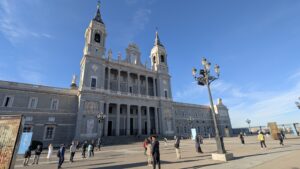
We then went for a driving tour around the city. There is so much interesting architecture everywhere, it oozes history.
We stopped and had a look around the Plaza de Torros, Madrid’s Bullring. 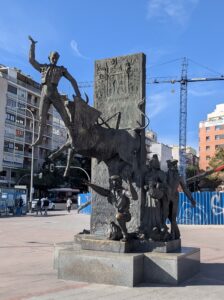 The first bull fights in Madrid took place in the 1400’s. Bull fights are held regularly throughout the year, about 1 a month except for a couple of festivals a year where they may have 25 days in a row of Bull fights. A typical session lasts about 2 hours and in that time there are 6 contests. Each bull is five years old and weigh over 500kg. Three bull fighters take on 2 bulls each in sessions of no more than 15 mins per bull. The bull must be killed inside the 15 minute time period. The arena holds around 24,000 people and is built in a neo- Moorish style, very decorative.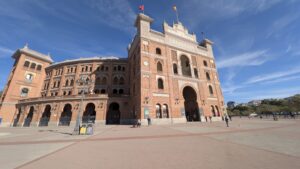
We did a drive by of the Real Madrid Stadium. It looks impressive but we couldn’t go in. The stadium has a capacity of 84,000, it has a closable roof and the pitch can be/is removed after each game. The grass pitch is grown and maintained underground! The stadium hosts concerts and other large events, so this maintains the quality of the playing surface, while allowing maximum use of the facility.
From there we went to the Prado Museum, it is an art gallery of over 100 rooms spread over 3 floors, and displays 9ver1,800 art works at any time. The collection came from Spanish monarchs, royalty and other benefactors. There are so many great artists displayed there. Our guide gave us a tour through the works of El Greco, Velazquez and Goya. It was fascinating getting insights into their styles and how you can tell which parts of their works that they actually painted, how they were composed in terms of lighting and perspective. We were given glimpses into the meanings behind their works. We had a quick look through other general displays before we left. An amazing collection.
From there we strolled across the road to the. Real Jardin Botanico. (The Royal Botanic Gardens). We always find gardens like these to be an escape from the “world”. They are always peaceful, cool and relaxing. We walked through their glass house and tree fernery, they were both surprisingly warm. From there we walked the perimeter, through avenues of olive trees and dense greenery, to displays of vegetable gardens and a mass planting of dahlias, many of which Deb had never seen before.
From there we walked back to our hotel, via a small eatery called Brunchit. We both had open Jamon and fresh tomato pulp sandwiches. They were delicious.
We then went back to our hotel to rest up before our Tapas Tour at 6:30pm.
We met our Tapas guide Fernando just outside of Plaza Mayo. He took us to our first tasting venue, “Mercado Jamon Iberico”. There we tasted Jamon Bellota (Jamon of from Iberian igs that had been fed only on acorns for the last 3 months of their lives, Lomo Bellota (pork loin of acorn fed Iberian pigs), Salchichon Bellota (a white cured sausage made from the meat of Iberian pigs), Chorizo Bellota (Chorizo made from Iberian pigs), and Oveja Curado (Mature Sheep’s cheese). This was served with a plate of premium olive oil and crust bread. Everything was so flavoursome. I think my favourite was the Lomo Bellota.
We left there and walked to our next and final tasting at “Rincon De La Cava. On the way we passed by the worlds oldest continually run restaurant “ Restaurante Sobrino de Botin Horna de Asar”, which has been running from the same premises since 1725.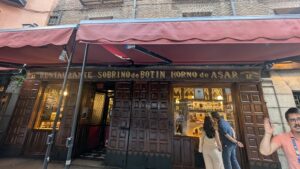
For our next tasting we had Whole Salted Fried Green Peppers, Sliced Mushrooms with galic and olive oil, a Spanish Omlete (eggs & potato) and Jamon on Toast. Everything was delicious.
To finish the night Fernando took us back near Plaza Mayor to one of his favourite gelato shops, where we said good byrpe to him and we both go a gelato cup to eat on our walk back to our hotel. A great way to finish our busy day.
