https://www.facebook.com/Greganddebstravelblog?mibextid=ZbWKwL
#Retiredlyf
We met our guide Laura outside the Lamaro Hotel at a bit after 9am, it took us a little longer than we thought (and what Apple maps & google maps thought).
After we got to know each other a little bit, Laura began to give us an abridged history of Barcelona. Barcelona has been inhabited since about 2500bc, Iberian tribes inhabited the area until the arrival of the Romans in the 1st Century, it became a strategic outpost. The Romans built it into a walled town with fresh water via an aqueduct. After the fall of Rome the Visigoths took control of the region until the 8th century, when the Muslims took control. Their reign lasted a little over 1 century when Charlemagne’s son Louis the Pious captured the city, and established the County of Barcelona. Catalan Identity: By the 12th century, Barcelona was under the control the of the Crown of Aragon, and had influence across the Mediterranean. During the 1714 War of Spanish Succession, Barcelona fell to Bourbon forces, which lead to the suppression of Catalan institutions. As the 19th century arrived the Industrial Revolution brought rapid industrialization, urban expansion, and the birth of Modernisme, with iconic architecture by Antoni Gaudí. During the Spanish Civil War, Barcelona was a Republican stronghold and suffered greatly under Franco’s dictatorship. The Catalan Identity remains strong and the city remains a focal point in the ongoing debate over Catalan independence. After Franco’s death in 1975, Barcelona re-emerged as a vibrant cultural capital. The 1992 Olympics was a turning point that modernized infrastructure and boosted global recognition.
Where we stood it was easy to see clear evidence of the Roman settlement of the area, with remnants of the old city walls and an aqueduct were clearly visible. The old town walls existed up until the mid 19th century, when they gave way to the expansion of the city.
The city as we know it now was built in the late 19th, early 20th century. With the grand Avenue and the building of the grand buildings throughout the city. It was at this time that Gaudi left his mark on the city (but more about that tomorrow).
Looking at a map of Barcelona today, it is very easy to see the new (19th/20th century) sections of the city and the old 18th century and earlier sections. The new city has wide open planning and a structured grid street pattern, where the old sections retain their roots as old villages, with narrow streets and a very random looking layout. On our walk through the Borne neighbourhood we came across what is the narrowest street in the city, Carter de la Mosques (Street of the flies). We also walked down Carrer Montcada the widest street in the old town, it was home to wealthy merchants, where they built their palaces. The Port is at far end of the street allowed the merchants to have direct access from port to city.
It is in five, yes 5, of these palaces that today you find the Picasso Museum. Picasso was born in Malaga, just down the coast from Barcelona, in 1881. His father was an art teacher and artist, he very early recognised his son’s talent and had him schooled in the arts from a young age in Barcelona. Prior to his death in1983, Picasso donated a huge collection of his works to the City of Barcelona. It is this collection that is on show. It traces his whole life through his artwork. There are pieces from when he was 5 or 6 years old and then through every stage of his life. You can vividly see his works improve and change through his life, he was always at the forefront of emerging art styles but could never be categorised as being of 1 style. He lived in Barcelona at the height of Modernisme and socialised extensively at Els Quatre Gats, the café that was a hub for the movement. But he quickly evolved beyond Modernisme. He pioneered Cubism, explored Surrealism and Neoclassicism, and all the avant-garde forms that were defining modern art. He is credited with revolutionizing modern art.
There were so many pieces that grabbed me in the museum, some of my favourites were “Cliper, the Artist’s Dog”, “Science and Charity” (it is very different depending on where you view it from)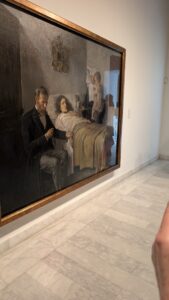
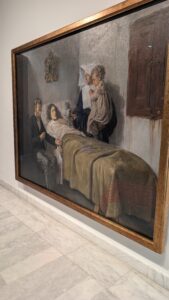 , Joseph Cardona i Furro”, all of his sketch books and preliminary sketches
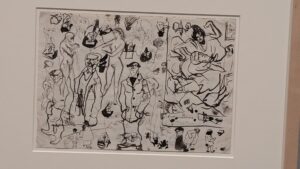 , “La Chata”, “Gored Horse”, “ Fruit Bowl”, “Las Meninas” ( his B&W take on Diego Velazquez’s painting, and the whole Picasso Las Meninas collection)
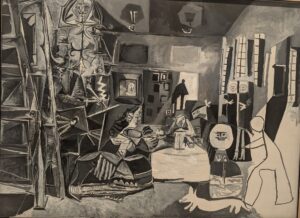 , “Vase” and finally “Owl with Chair on Ochre Background”
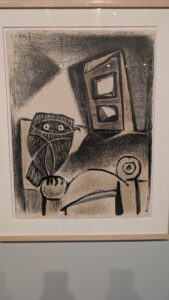 . His ceramic works gave him another dimension to work in. It was a very enjoyable couple of hours.
After we left the museum we walked the old streets a bit more, we came across Capella d’en Marcus, a small 1166 Romanesque chapel, a great small piece of history.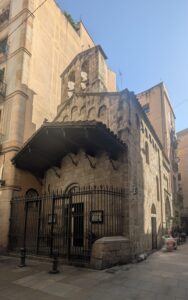 We next came to Mercat Santa Caterina, the oldest (1848) undercover market in Barcelona. The produce here looked as good as any market we have seen in Europe this trip. On we went to the Palau de la Musica Catalana, (unfortunately there was an event on inside and we couldn’t go in), but its facade was amazing. It is an UNESCO World Heritage site for its architecture. A little way down the street we came to a social phenomenon shop, “Caganer”. This shop sells Caganers, these originated as small figurines placed in Catalan nativity scenes, they are characters depicted in the act of defecation. The name literally means “the pooper” in Catalan.
 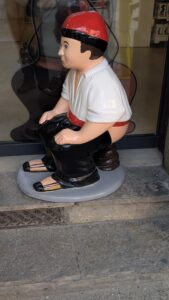 The pieces have evolved, and the shop now sells figurines of globally famous people from politicians, to actors, sports stars, comic characters, etc all in the act of pooping.
It was here we said good by to Laura for today, we have her as our guide tomorrow.
Deb and I walked back to the market and had lunch, a fresh salad and ham & chicken croquettes. The salad was great.
We then took the Ingress way back to our hotel, along the way we saw many really interesting building and parks in the city, including a couple of buildings by Gaudi.
We had a great day out exploring, for some reason Barcelona reminds us of Buenos Aires, the same rich feel.
Subscribe to our blog
Search our site
Site Visit counter
Visits since 1 Feb 2020

1234,544 visits up to 31 Jan 2020Log in
Pages
- About this Site
- GregnDeb by Map
- 2006 England, Scotland and Italy
- 2007 Central Australian Outback
- 2007 – 2008 Antarctica and South America
- 2008 Vietnam & Cambodia July-Aug
- 2008 Great Ocean Road & Kangaroo Island Oct with G&J
- 2009 Around the World Apr-Aug
- 2009 Mallacoota, Wilsons Promontory and Halls Gap Oct
- 2010 North America & Alaskan Inside Passage Cruise
- 2011 Western Half of Australia Jul-Ag
- 2013 Carnival Spirit Pacific Cruise
- 2013 India
- 2015 Carnival Spirit Cruise
- 2015 Chile, Galapogas, Cuba, Mexico & USA
- 2016 Norfolk Island
- 2016 Eastern Australia Tour July to Sept
- 2018 Africa July
- 2018 China and Hong Kong in May
- 2018 New Zealand Adventures April
- 2019 England, Scotland, Iceland and Ireland May to Aug
- 2023 Greece, Croatia and England
- Short Breaks in Australia
- More Photos
- Our COVID-19 Life
- Our Travels 2006 to 2010
- 01. 2010 North America
- 02. 2010 Adelaide to Gosford to Sydney to Canberra to Adelaide
- 03. 2010 Australian Open Tennis Melbourne January
- 04. 2009 Around the World
- 05. 2009 Mallacoota, Wilsons Promatory and The Grampians
- 06. 2008 Great Ocean Rd, Kangaroo Is & Adelaide
- 07. 2008 Vietnam & Cambodia
- 08. 2007 – 2008 Antarctica and South America
- 09. 2007 Central Australian Outback
- 10. 2006 UK and Italy Aug & Sept
- 11. 2006–2009 Short Trips & Plans
- Useful Travel Info Sites
- Zero Hr COVID-19
- #01 November 2019 & January 2020 – The Novel Coronavirus begins and breaks out
- #02 February 2020 COVID-19 Spreads Globally
- #03 March 2020 COVID-19 It Spreads very widely
- #04 April 2020 COVOD-19 The world tries to deal with Covid-19
- #05 May 2020 COVID-19. A new “Normal”
- #06 June 2020 Covid-19 Things are getting worse
- #07 July 2020 Covid-19 Complacency is our greatest danger
- #08 August 2020 Covid-19 Globally No Better No Worse, Victoria from Good to VERY Bad
- #09 September 2020 Covid-19 Globally it’s getting Worse, Victoria is back on track.
- #10 October 2020 Covid-19 The Pandemic takes hold Globally
- #11 November 2020 Covid-19
- #12 December 2020 Covid-19 The End of 2020 – We have vaccines and the hope of a brighter 2021
- #13 January 2021 Covid-19 The start of a new year with promise
- #14 February 2021 Covid-19 The “New Normal” has become normal
- #15 March 2021 Vaccinations in Australia begin and so does the Global Third Wave.
- #16 April 2021 The Third Wave is continuing to grow.
- #17 May 2021 The Third Wave comes and goes, where now?.
- #18 June 2021 The “Third Wave” is over, but hello the Delta Variant!
- #19 July 2021 The Delta Variant has arrived and brought on a 4th Wave of Covid-19
- #20 August 2021 Covid-19 Same Same but Different, Delta Dominates
- #21 September 2021 We ride the 4th wave
- #22 October 2021 The Fourth Wave is over, what next?
- #23 November 2021 Looks like Omicron is riding the 5th wave
- #24 December 2021 And then there was Omicron
- #25 January 2022 The month of Omicron
- #26 February 2022 Omicron fades away
- #27 March 2022 Covid-19 Australia’s 6th Wave and a Global Steady State.
- #28 April 2022 Covid-19 is declining world-wide, but comes close to home
- #29 May 2022 The numbers of Covid-19 “reported” are continuing to decline
- #30 June 2022 The Pandemic has stabilised, or has it!!
- #31 July 2022 Another wave of Covid-19 washes over us.
- #32 August 2022 The decline of the Omicron Wave
- #33 September 2022 A Political End to the Pandemic
- #34 October 2022 Covid-19 Diary
- #35 November 2022 Covid-19 Diary
- #36 December 2022 The West Begins to Normalise as China sets Covid-19 free.
- #37 January 2023 Covid-19 Let’s look the other way, it might go away!
- #38 February 2023 Covid-19, Don’t mention it!
- #39 March 2023 Covid-19 Now Endemic
- Covid-19 Charts Jan 2022 to end April 2022