We met our guide in the hotel lobby for a walking tour of Porto. His name is Goncalo.
We started our tour at the Porto Train Station , it was formerly a monastery but was resumed by the Portuguese government at the end of the Portugal civil war in 1834. In 1896 it was converted to train station when last nun died. The main entrance to the station has vast mosaics covering its walls. The mosaics tell the history of Portugal.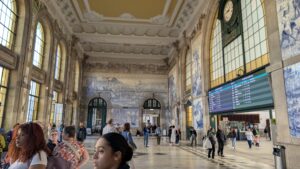 It was a really interesting way to learn their history, by story and graphics. It covers the times since the fall of the Roman Empire, the Visigoths period, Moors, Christians, trading, wine, exploration and a few local legends. Without Goncalo, it would have just been a meaningless four walls of blue tiles pictures.
A few interesting facts to come out of our visit. A School of Navigation was set up in Porto by Prince Henry the Navigator (the Head of the big statue of that name in Lisbon). He set the school up after his first return voyage to the new world so other Portuguese explorers learnt the knowledge he developed on his voyage. The inhabitants of Porto are known as “Tripe Eaters” , this is because that was primarily all that was all that was left eat after their explorers ships were provisioned with the better cuts of meat. We hadn’t heard the term Visigoth until we arrived in Portugal. It’s a term used to describe the Nordic tribes that came down to Portugal and dominated the region from the 5th to 8th century. (Think Vikings types). Green wine vines were originally grown up the trunks of trees to protect them from grazing livestock. Today one of the most prized Green Wines comes from Alvarinho grapes from the Melgaco region. The Portuguese drink an average of 60 litres of wine each per year.
In 1179 Portugal declared itself an independent country.
We walked all over the old part of Porto, looking at the buildings, learning more of its history and quirky behind the scenes things. Porto has one of the most famous bookstores in the world, we walked passed it. There was a very long queue of people outside patiently waiting to go in. The main plaza in the new part of town was designed by a British architect in the late 19th / early 20th century, I thought the building style(s) looked familiar.
A curiosity in Porto is the iconic twin churches, a pair of churches built side by side: the Igreja dos Carmelitas Descalços (the church on the left built in 17th century) and the Igreja do Carmo (the church on the right built in the 18th century). 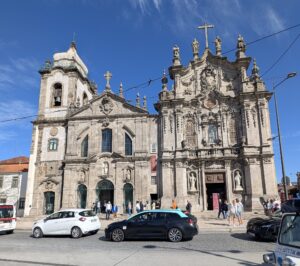 Under Portuguese law it was illegal to build churches side by side. So to get around this, a narrow three-foot-wide house, often called the “Casa Escondida” or Hidden House, was built between them. The house was inhabited until the 1980’s, it is now a museum.
The area around the twin churches is a place where to pilgrimage paths intersect. To assist the Pilgrim each path has a different coloured arrow to define the correct direction the pilgrims should take. Those on the Caminos de Fatima Pilgrimage follow blue arrows and those on the Portuguese Way of St. James (Caminho Português) follow the yellow arrows.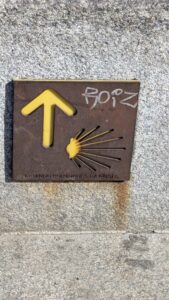
When we were in Lisbon we were told that Porto was a dark city and Lisbon was a light city, this comes back to Lisbon’s building favouring limestone and Porto’s favouring granite. The granite craftsmanship in Porto is amazing, the detailed masonry is a testament to their craftsmanship and patience
We had a look through the Museum of Commerce, another converted Monastery. The main courtyard surrounded by the old cloisters has many symbolic mosaics crafted into the floor and walls. 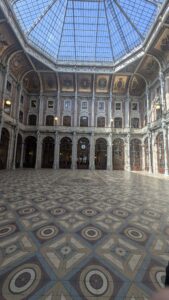 The museum is a time capsule of Portugal’s golden era of trade, and the riches it brought.
From there we walked through the old Jewish part of town and down close to the Douro River. We said good bye to Goncalo and had lunch overlooking the River on Rua De S.Nicolav, at Restaurant Adega Soa Nicolau. We both had grilled Sea Bass, it was very good.
After lunch we walked back up the hill and over to the Ponte Luis I ( the Luis I Bridge ). It was reasonably busy with tourists crossing over and taking lots of photos. There is also a regular tram service each way across the bridge, the tam drivers make good use of their horns to warn errant tourists away from the tram lines. We did the tourist thing, walk over and back across the bridge and took the required photos and selfies.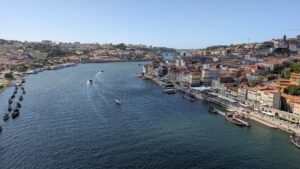
From there we followed the road into town and back to our hotel. A really interesting day.
Subscribe to our blog
Search our site
Site Visit counter
Visits since 1 Feb 2020

1234,544 visits up to 31 Jan 2020Log in
Pages
- About this Site
- GregnDeb by Map
- 2006 England, Scotland and Italy
- 2007 Central Australian Outback
- 2007 – 2008 Antarctica and South America
- 2008 Vietnam & Cambodia July-Aug
- 2008 Great Ocean Road & Kangaroo Island Oct with G&J
- 2009 Around the World Apr-Aug
- 2009 Mallacoota, Wilsons Promontory and Halls Gap Oct
- 2010 North America & Alaskan Inside Passage Cruise
- 2011 Western Half of Australia Jul-Ag
- 2013 Carnival Spirit Pacific Cruise
- 2013 India
- 2015 Carnival Spirit Cruise
- 2015 Chile, Galapogas, Cuba, Mexico & USA
- 2016 Norfolk Island
- 2016 Eastern Australia Tour July to Sept
- 2018 Africa July
- 2018 China and Hong Kong in May
- 2018 New Zealand Adventures April
- 2019 England, Scotland, Iceland and Ireland May to Aug
- 2023 Greece, Croatia and England
- Short Breaks in Australia
- More Photos
- Our COVID-19 Life
- Our Travels 2006 to 2010
- 01. 2010 North America
- 02. 2010 Adelaide to Gosford to Sydney to Canberra to Adelaide
- 03. 2010 Australian Open Tennis Melbourne January
- 04. 2009 Around the World
- 05. 2009 Mallacoota, Wilsons Promatory and The Grampians
- 06. 2008 Great Ocean Rd, Kangaroo Is & Adelaide
- 07. 2008 Vietnam & Cambodia
- 08. 2007 – 2008 Antarctica and South America
- 09. 2007 Central Australian Outback
- 10. 2006 UK and Italy Aug & Sept
- 11. 2006–2009 Short Trips & Plans
- Useful Travel Info Sites
- Zero Hr COVID-19
- #01 November 2019 & January 2020 – The Novel Coronavirus begins and breaks out
- #02 February 2020 COVID-19 Spreads Globally
- #03 March 2020 COVID-19 It Spreads very widely
- #04 April 2020 COVOD-19 The world tries to deal with Covid-19
- #05 May 2020 COVID-19. A new “Normal”
- #06 June 2020 Covid-19 Things are getting worse
- #07 July 2020 Covid-19 Complacency is our greatest danger
- #08 August 2020 Covid-19 Globally No Better No Worse, Victoria from Good to VERY Bad
- #09 September 2020 Covid-19 Globally it’s getting Worse, Victoria is back on track.
- #10 October 2020 Covid-19 The Pandemic takes hold Globally
- #11 November 2020 Covid-19
- #12 December 2020 Covid-19 The End of 2020 – We have vaccines and the hope of a brighter 2021
- #13 January 2021 Covid-19 The start of a new year with promise
- #14 February 2021 Covid-19 The “New Normal” has become normal
- #15 March 2021 Vaccinations in Australia begin and so does the Global Third Wave.
- #16 April 2021 The Third Wave is continuing to grow.
- #17 May 2021 The Third Wave comes and goes, where now?.
- #18 June 2021 The “Third Wave” is over, but hello the Delta Variant!
- #19 July 2021 The Delta Variant has arrived and brought on a 4th Wave of Covid-19
- #20 August 2021 Covid-19 Same Same but Different, Delta Dominates
- #21 September 2021 We ride the 4th wave
- #22 October 2021 The Fourth Wave is over, what next?
- #23 November 2021 Looks like Omicron is riding the 5th wave
- #24 December 2021 And then there was Omicron
- #25 January 2022 The month of Omicron
- #26 February 2022 Omicron fades away
- #27 March 2022 Covid-19 Australia’s 6th Wave and a Global Steady State.
- #28 April 2022 Covid-19 is declining world-wide, but comes close to home
- #29 May 2022 The numbers of Covid-19 “reported” are continuing to decline
- #30 June 2022 The Pandemic has stabilised, or has it!!
- #31 July 2022 Another wave of Covid-19 washes over us.
- #32 August 2022 The decline of the Omicron Wave
- #33 September 2022 A Political End to the Pandemic
- #34 October 2022 Covid-19 Diary
- #35 November 2022 Covid-19 Diary
- #36 December 2022 The West Begins to Normalise as China sets Covid-19 free.
- #37 January 2023 Covid-19 Let’s look the other way, it might go away!
- #38 February 2023 Covid-19, Don’t mention it!
- #39 March 2023 Covid-19 Now Endemic
- Covid-19 Charts Jan 2022 to end April 2022