
Today we headed east into the Douro Valley, the home of true Port wine. To get there we went through the longest vehicle tunnel on the Iberian peninsula, 5.7km long, Tunnel Do Maroa.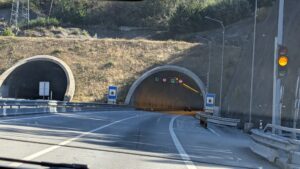 There were scars on the hilltops and down some slopes from bushfires earlier in the year. Europe in general has had a bad year for bushfires.
The area has no discernible dairy industry, it’s too hilly and dry, so the gastronomy is all about wine, olive oil and bread.
The quote of the day attributed to Percy Croft of the Douro Valley Croft family is,
“Any time you don’t spend drinking port wine is a waste of time”.
The Douro Valley is about 1.5hrs east of Porto. The region is dominated by hills, the highest point is 2100 ft above sea level, the river in the Valley is 60m above sea level. There are approximately 250,000 hectares under vine in the region. Wine has been grown in the area since Roman times. Port wine has been produced in the Valley since about the 17th century. It became the world’s first demarcated wine region in 1756. The soils in the region are shale based with spots of granite. By law, all vines are dry grown, there is no irrigation allowed for grape growing. This results in the rows of vines being in low tonnage yields. There are at least 3 methods used to grow the vines, the familiar row trellis method, vines grown so they form an arch between rows and terraced vines.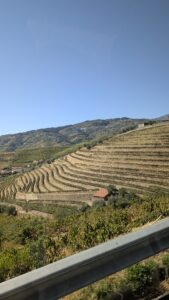
The Douro Valley has a harsh climate, locals describe it as “9 months of winter and 3 months of hell” in recent times it has become 6 months of hell, due to the extreme heat ie mid 40’sC for long periods has become common in recent years.
There are large noticeable areas of former vineyards, known locally as “Cemetery Vineyards”, most of these areas were tenuous at best but when the region was devastated by the phylloxera outbreak of 1850-1860, they never recovered. The phylloxera came from America.
We started our day in the Valley with an hour long boat ride on the river. It is the perfect way to get to know the Douro Valley. You can very easily see the hills that dominate the landscape, and how the grapes are grown and cared for. Everything has to be done by hand, no machinery is used in grape production. Up to 20,000 people come into the valley at picking time. The boat trip was aboard a boat fashioned along the lines of a traditional Rabelo boat. The boats that were used to transport up to 50 or 60 barrels of wine/port at a time downstream to Porto. There were only 6 passengers on our boat, so it was very relaxing. 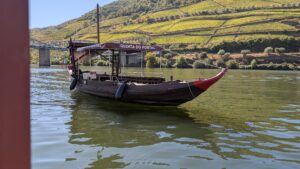 We saw some of the biggest Port company’s vineyards and wineries (Croft and Royal Porto to name a couple) as we cruised.
From there we went to the Pedro Milanos Winery, where we were met by the winemaker Vasco, and his mother Luisa. We had a delicious lunch cooked up by Luisa and guided wine tasting by Vasco. A memorable time. They are so passionate about their wines, we tried 5 distinctly different wines, and each was very good. It’s rare that we find we like all wine in a tasting.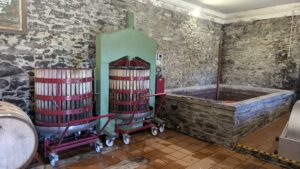
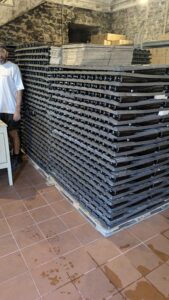 They don’t make any port due to the Port rule of 3 that producers must meet. If you make port you must make 1/3 tawny & 2/3 vintage. This makes it impractical for small vineyards, due to the cellaring space and time required
From there we went to Pacheca Wines, for a tour and tasting. We got shown through their port production areas, from crushing to fermentation to storage in barrels. We learnt a lot about the process and the different types of Port.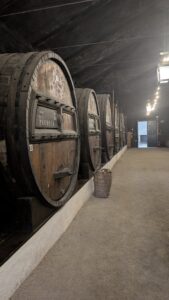
There are 4 types of Port – Tawny, Ruby, White & Rose.
All ports go through a period of time in french oak, this gives it colour and oxidises the wine.
Tawny Ports do not age in bottle, their character is set as soon as they are bottled.
The premium style of Port is Ruby Port. After between 2 and 6 years in barrels, it is then transferred for further development age in big casks. It is then bottled. There are several types of Ruby Port, Vintage, which is the highest quality, and continue to improve with age in the bottle, LBV (Last Bottled Vintage) that is good for up to 25yrs in bottle, Ruby Reserve – 5 years in barrel. All Vintage ports are bottled unfiltered to assist their aging.
Port should be drunk at around 14 to 16C to get the best flavour from the wine. Vintage port should be consumed within 2 or 3 days of opening, tawny’s can last 4_5 months and should be stored in the fridge once opened, it keeps the flavour better.
If you have any doubt about the integrity of the cork in a very old vintage port you should use the Portuguese way of opening it, heat the neck of bottle to very hot, then chill with cold water, this breaks the neck in a perfect circle and there is no issue with Cork spoilage. ( https://youtu.be/HxjkFqGQLkY?si=FFC1hRLkQhbKqqik ) The wine should be filtered and decantered before drinking. Of the 4 wines we tried at Pacheca, Only enjoyed the Tawny.
And that concluded our time in the Douro Valley. We got back to our hotel around 6pm. We leave for Madrid early tomorrow.
(I hope I got all the wine making things correct, apologies in advance for any errors, I wrote this after the tastings 🙂 )
Number of Views :167
