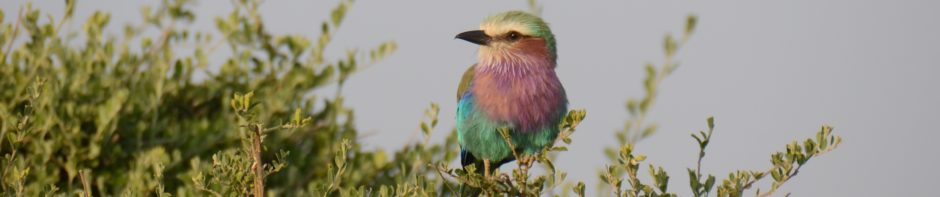
Our driver. Young Carlo, picked us up at 9am and we were on our way to the former capitol, Toledo.
Modern Toledo has been a UNESCO World Heritage Site since 1986, Its historic centre was recognized for its architectural and cultural significance, and the coexistence of Judaism, Christianity, and Islam.
Toledo’s history goes back over 2000 years , the Roman Empire captured the Carpeta fortified city of Toletum in 193 BCE. They made it a Roman municipium with public baths, a circus, and aqueducts. In the 6th century it was the capital of the Visigothic Kingdom. It was the scene of many important church councils, including the Third Council of Toledo in 589, marking King Recared’s conversion to Christianity.
Between 712–1085 it under Moorish control, Toledo became a centre of Arabic-speaking Christian (Mozarabs) and Islamic culture. It was part of the Emirate of Córdoba and known for its tolerance and scholarly exchange. In 1085, King Alfonso VI of Castile captured Toledo, integrating it into Christian Spain. The city flourished as a cultural melting pot, especially under Alfonso X, who founded the famed School of Translators, bridging Arabic, Hebrew, and Latin scholarship. In the 16th Century, Toledo briefly served as the imperial seat under Charles V. However, its influence diminished after King Philip II moved the capital to Madrid in 1561.
There was a short period traffic jam on the way to Toledo, but we made it there in about an hour. Looking at the city as we drove in it has 2 distinct sections, old and new. We were there to have a look at the old.
We met our guide Maria at the south east gate to the old city, we walked in and up to an old church/monastery, (there are over 80 churches in old Toledo) the Monasterio de San Juan. 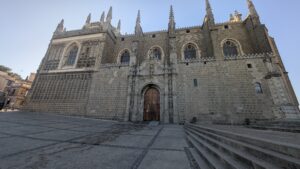 It is one of Spain’s best examples of Isabelline Gothic architecture. It was built between 1477 and 1504. The main facade features a grand entrance door with an impressive coat of arms, many gargoyles and a huge studded wooden door, and a display of chains, hung high on the left hand side, once worn by Christians who were freed from imprisonment in Granada. There was a modern statue of Jesus with a hula-hoop in front of the monastery.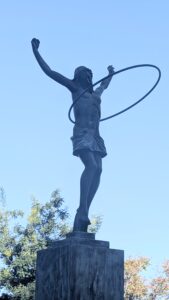
We walked from there into the old Jewish section of the city and onto an old Synagogue. Along the way we saw small blue tiles fixed to the pavement and at ground level on buildings, they depicted a “menorah” and are used to define the “boarders” of the Jewish area. We went into an old Synagogue, it is now a museum, but it was in its last use a Christian Church. It was built by Arabian builders and so has numerous Arabic/Islamic symbols and architecture built into it. 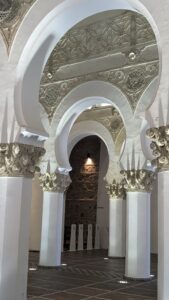 Whilst much of the original Synagogue had been altered (notably the womans and childrens gallery had been removed) it still retained many original features. I liked the orange glow that came from the alabaster windows.
We left there and went to pastry shop to try the famous locally made Marzipan. The area grows many almonds and it has spawned a Marzipan industry. We bought some to try a bit later. ( We tried them when we got back to our hotel, they were good, there was no overpowering flavour of amaretto or sugar, rather a just sweet enough, smooth chewy almonds paste).
From there we had a look through a ceramics shop. We were told the old city had a maze of tunnels under it and that most residences had there own cistern to supply them with water during the long dry months. We were able to walk down maybe 5m under the shop to see the old brickwork arches supporting tunnels (for this shop the tunnels are now display rooms).The shop has an old cistern directly under the floor of the tunnels. The city did not get running water until the 1940’s.
As we walked around the narrow cobblestone streets it was pointed out that many of the older buildings in the city had history build into them. Each new ruling “empire” in the city used the building stones of previous empires to add there touch to the city. So many walls could be seen that had walls like an archaeological dig, with many layers showing who had live there before. The period on Napoleonic occupation of the city saw many historic objects around the city damaged by the troops.
We finished our tour with a guided walk through the Toledo Cathedralk officially known as the Primatial Metropolitan Cathedral of Saint Mary of the Assumption. 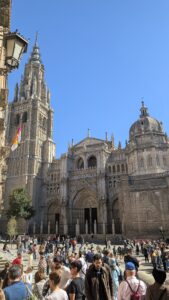 It is one of Spain’s most iconic Gothic buildings. Construction began in 1226 and was completed in 1493. In this long period its architecture evolved from an Early Gothic Phase (1226–1300), to High Gothic Phase (1300–1400) and finally Late Gothic Phase (1400–1493). The cathedral was consecrated in 1493. Many Islamic artistic influences can be seen through out the building, especially in the Moorish windows
The cathedral houses works by El Greco, Goya, Velázquez, and others, we may have seen some of these works without knowing who did them. The cathedral is home to A golden tower-like structure in the Toledo Cathedral is the Monstrance of Corpus Christi. Said to be one of the most extraordinary pieces of religious gold work in the world. It is about 2.5m tall and weighs over 200kg, it took 7 years to build from 1514 to 1521. It is displayed directly under the bell tower.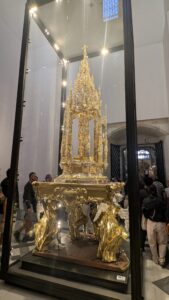
The cathedral has 3 organs and all are played regularly, with a once a year competition held where organ players come to play “ a battle of the organs”.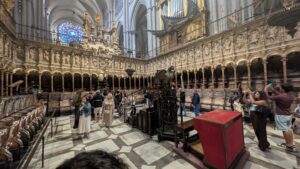
There are over 700 stained-glass glass windows in the cathedral, all very colourful and bright when we were there.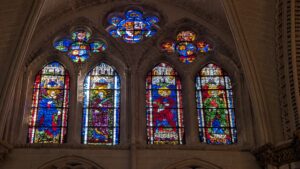
The Cathedral was huge, and a lot to take in in a very short period. We had a little under an hour in the cathedral.
We met up with driver at about 1:05 and were on our way back to Madrid. About halfway back I felt a tickle on my left ankle, I looked down and saw it was a bee. I picked it up by the wings and set it free out the window ( at 120 kph). We made it home safely, I’m not sure how the bee is!
We went out a bit later to have dinner. Deb had seen a small restaurant/Cafe when did our tour yesterday that did squid rolls, our guide recommended them, so we went to try them out. They were a little dry, but very generous with squid and tasty. We ate them not far from Kilometre Zero, without knowing it.
We then found the nearest Valor Churreria Choclateria to us, sat at a table outside and ordered Churros and Hot Chocolate. We got served 4 freshly fried churros and a cup of the thickest hot chocolate we have ever had, it was more like a dipping sauce than a drink. So that’s exactly what we did, churros in the chocolate, it was not too sweet, not deep fried flavour and very chocolatey. Once the churros were finished we both tried the hot chocolate “drink”. It was so thick and full on hot chocolate flavour!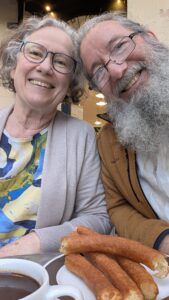
We walked back to Kilometre Zero via what looked like Madrid’s equivalent to Times Square. Tall narrow ended buildings and sky high led advertising screens. There were so many people out and about in the square and all the major retail roads around it.
From there went walked back to have a look at Puerta del Sol or “Kilometre Zero”, the exact point in Madrid that is the centre of the radial network of Spanish roads.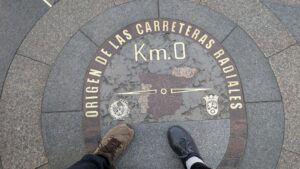 It took us a little time to find it, but eventually the small queue of taking selfies of their feet gave it away. A bit quirky but interesting.
After that we played a bit of Ingress and took down some big annoying blue fields before we headed back to our hotel. We had a fun day.
It’s a travel day tomorrow, a high speed train to Seville.
Number of Views :178
