At about 8:40 we headed out for a half day tour of Seville, taking in the Cathedral, Royal Alcázars and to explore what makes the essence of Saville.
Unfortunately our tour company had changed our schedule and forgotten to tell us. We eventually rescheduled our tour for 2pm.
So we took a walk down to the river and found the Bull Ring was open, so we went in and had a look around. It was built in the 18th century, making it one of Spain’s oldest Bullrings. It was built in a blend of Baroque and Newcastle’s with an ornate facade and ma y archways. It is considered the one of the most prestigious bullring in the world and regularly hosts bull fights. It has a museum dedicated to bull fighting, its equipment people, costumes and of course the bulls. It was really interesting to look around. The seating is hard, all seats are concrete/brick, with the higher priced seats having a little more room. General admission cost from 20 to 60 euro with premium seats costing up to 200+ euro. The stadium seats around 12,000. The bullring itself was a raked orange clay, it looked similar to the colouring of clay tennis courts. You could very easily imagine the roar of the crowd when you sat in the stadium.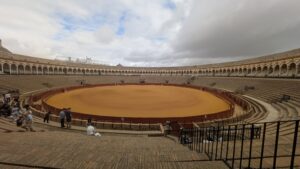
We left the bullring and walked up to the Triana Bridge Puente de Isabel II (Puente de Triana), or Isabel II Bridge for short. 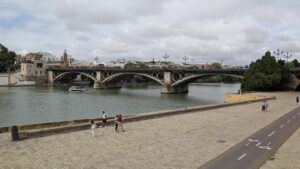 It was a bridge we saw all lit up last night and it looked interesting. It has an interesting shape and is one of 10 bridges that cross over the Canal de Alfonso XIII. We walked about half way across it took some photos and then walked back to our hotel to recharge us and our devices ready fir our afternoon. We picked up a Jamon Roll each for lunch, Spanish ham is the absolute best.
We left of hotel again at about 1:40 and met our guide, Doria, at 2pm. We did an interesting quick walk through the Jewish Quarter of the old city before lining up for our 2:30 tour through the Saville Cathedral, there was a delay of some sort, but we eventually got into at about 2:50pm. The cathedral sits on the site of a 10th century mosque, the mosque was converted into a church in the 13th century when Christians retook the city. Construction of the Cathedral began in 1402 and it was completed in 1519.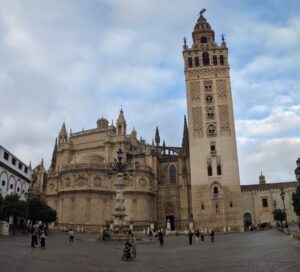 The time it took to build resulted in many architectural styles being incorporated into the building, resulting in a primarily Gothic building with Renaissance and Moorish features. The bell tower, known as The Giralda Tower, was originally a minaret and one of Seville’s most notable landmarks. We can test to the quality and volume of the bells!! Inside the Cathedral is a tomb dedicated to Christopher Culumbus, it contains some of him! But not a lot. The main Alter is the largest Alter piece in the world and is made of gold covered wood, it took nearly a century to make. You can climb to the top of the belltower via 34 ramps, but our tour time didn’t allow us the opportunity. Apparently the views over Seville are magnificent. There are 45 chapels within the Cathedral, including a Chapel Real (Royal Chapel) that is the burial site of King Ferdinand III, Alfonso X, and other Castilian monarchs.
 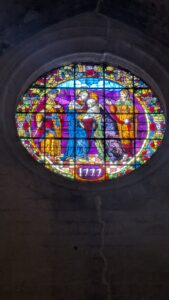 It was closed and only opens for Royalty. The Sacristy and Chapter house and the many Chapels hold numerous works of famed artists including Murillo, Zurbaran and Goya. adorned
The Cathedral’s organ is one of the most historic and impressive in Europe with over 7000 pipes. We heard it playing in the morning and it sounded amazing.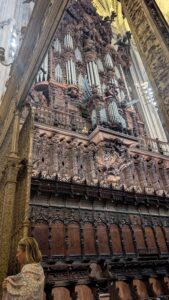
The tour was rushed, we had a 3:30 booking for a tour through the Royal Alcazars. We left the Cathedral at about 3:25 and joined a queue the the Alcazars at 3:30.
The Royal Alcazars are a UNESCO World Heritage Site and one of Europe’s oldest palaces still in use. It has a long diverse history. It was first built as a Moorish Palace in the 10th century, and was extended over centuries by Christian monarchs, blending a mix of Islamic, Gothic, Renaissance, and Baroque styles.
It has three distinct sections, the Salon de Embajadores – a lavish throne room featuring a gold domed ceiling, the Palacio Hot icon – a Gothic wing built after the Christian reconquest by Alfonso X and the Patio de Las Doncellas – that features a courtyard with a reflection pool and Mudejar arches, and the summer bedrooms.
There were so many highlights walking around the palace buildings, the intricate mosaics throughout were stunning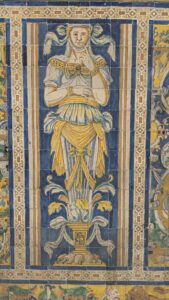 , the Moorish wood carved panels that feature extensive are always impressive,
 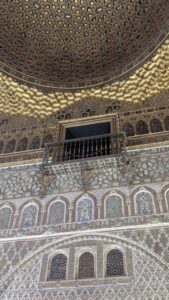 a vast array of royal and biblical artworks many walls, and the very impressive room of huge tapestries, about 40 sq m each.
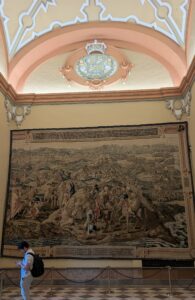 It is estimated that it took between 5 and 7 years from commission to installation.
Our guide said good bye to us and left the garden for us to explore alone. The gardens are a mix of Moorish, Renaissance, and modern styles. There are many hedges, maze like features, fountains groves, palms and hidden courtyards. 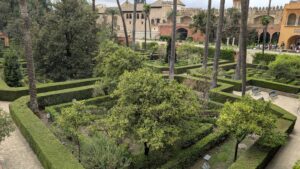 The are very extensive, we viewed them from an elevated gallery on a wall that separated the very formal gardens from the less formal.
We left the Alcazars at around d 5:15 and walked back to our hotel, stopping for an ice-cream on the way.
The end of a mixed (somewhat disappointing) day.
Subscribe to our blog
Search our site
Site Visit counter
Visits since 1 Feb 2020

1234,544 visits up to 31 Jan 2020Log in
Pages
- About this Site
- GregnDeb by Map
- 2006 England, Scotland and Italy
- 2007 Central Australian Outback
- 2007 – 2008 Antarctica and South America
- 2008 Vietnam & Cambodia July-Aug
- 2008 Great Ocean Road & Kangaroo Island Oct with G&J
- 2009 Around the World Apr-Aug
- 2009 Mallacoota, Wilsons Promontory and Halls Gap Oct
- 2010 North America & Alaskan Inside Passage Cruise
- 2011 Western Half of Australia Jul-Ag
- 2013 Carnival Spirit Pacific Cruise
- 2013 India
- 2015 Carnival Spirit Cruise
- 2015 Chile, Galapogas, Cuba, Mexico & USA
- 2016 Norfolk Island
- 2016 Eastern Australia Tour July to Sept
- 2018 Africa July
- 2018 China and Hong Kong in May
- 2018 New Zealand Adventures April
- 2019 England, Scotland, Iceland and Ireland May to Aug
- 2023 Greece, Croatia and England
- Short Breaks in Australia
- More Photos
- Our COVID-19 Life
- Our Travels 2006 to 2010
- 01. 2010 North America
- 02. 2010 Adelaide to Gosford to Sydney to Canberra to Adelaide
- 03. 2010 Australian Open Tennis Melbourne January
- 04. 2009 Around the World
- 05. 2009 Mallacoota, Wilsons Promatory and The Grampians
- 06. 2008 Great Ocean Rd, Kangaroo Is & Adelaide
- 07. 2008 Vietnam & Cambodia
- 08. 2007 – 2008 Antarctica and South America
- 09. 2007 Central Australian Outback
- 10. 2006 UK and Italy Aug & Sept
- 11. 2006–2009 Short Trips & Plans
- Useful Travel Info Sites
- Zero Hr COVID-19
- #01 November 2019 & January 2020 – The Novel Coronavirus begins and breaks out
- #02 February 2020 COVID-19 Spreads Globally
- #03 March 2020 COVID-19 It Spreads very widely
- #04 April 2020 COVOD-19 The world tries to deal with Covid-19
- #05 May 2020 COVID-19. A new “Normal”
- #06 June 2020 Covid-19 Things are getting worse
- #07 July 2020 Covid-19 Complacency is our greatest danger
- #08 August 2020 Covid-19 Globally No Better No Worse, Victoria from Good to VERY Bad
- #09 September 2020 Covid-19 Globally it’s getting Worse, Victoria is back on track.
- #10 October 2020 Covid-19 The Pandemic takes hold Globally
- #11 November 2020 Covid-19
- #12 December 2020 Covid-19 The End of 2020 – We have vaccines and the hope of a brighter 2021
- #13 January 2021 Covid-19 The start of a new year with promise
- #14 February 2021 Covid-19 The “New Normal” has become normal
- #15 March 2021 Vaccinations in Australia begin and so does the Global Third Wave.
- #16 April 2021 The Third Wave is continuing to grow.
- #17 May 2021 The Third Wave comes and goes, where now?.
- #18 June 2021 The “Third Wave” is over, but hello the Delta Variant!
- #19 July 2021 The Delta Variant has arrived and brought on a 4th Wave of Covid-19
- #20 August 2021 Covid-19 Same Same but Different, Delta Dominates
- #21 September 2021 We ride the 4th wave
- #22 October 2021 The Fourth Wave is over, what next?
- #23 November 2021 Looks like Omicron is riding the 5th wave
- #24 December 2021 And then there was Omicron
- #25 January 2022 The month of Omicron
- #26 February 2022 Omicron fades away
- #27 March 2022 Covid-19 Australia’s 6th Wave and a Global Steady State.
- #28 April 2022 Covid-19 is declining world-wide, but comes close to home
- #29 May 2022 The numbers of Covid-19 “reported” are continuing to decline
- #30 June 2022 The Pandemic has stabilised, or has it!!
- #31 July 2022 Another wave of Covid-19 washes over us.
- #32 August 2022 The decline of the Omicron Wave
- #33 September 2022 A Political End to the Pandemic
- #34 October 2022 Covid-19 Diary
- #35 November 2022 Covid-19 Diary
- #36 December 2022 The West Begins to Normalise as China sets Covid-19 free.
- #37 January 2023 Covid-19 Let’s look the other way, it might go away!
- #38 February 2023 Covid-19, Don’t mention it!
- #39 March 2023 Covid-19 Now Endemic
- Covid-19 Charts Jan 2022 to end April 2022